

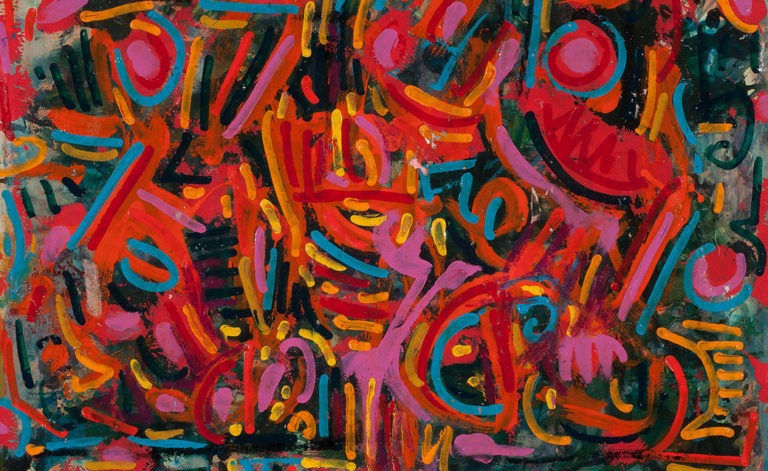
David Driskell was an African American artist, educator and writer. He was born in Eatonton, Georgia. He studied painting and art history at Howard University and wrote almost 50 books about Black artists. His art is influenced by many things, including racial segregation, jazz music, nature and African art.
 David Clyde Driskell (American, 1931 – 2020), “Masks,” 1988. Tempera and encaustic on paper, 19 × 25 inches. Georgia Museum of Art, University of Georgia; The Larry D. and Brenda A. Thompson Collection of African American Art. GMOA 2012.121.
Here, Driskell layers bright colors and different kinds of lines to create movement and energy. A line is any mark on a surface that is longer than it is wide. In art, lines can be straight, curvy, thick or zigzag. How many different kinds of lines can you find in “Masks”?
Artists use lines in different ways. Lines lead your eye around a work of art, create texture and show moods or emotions. Lines close together look darker. Overlapping lines create rough textures. Lines can seem nervous, happy, silly or angry. What do you notice about how Driskell uses lines in “Masks”? Are his lines calm or do they move? What do they remind you of?
In this activity, you’ll use chalk to find out how many different kinds of lines you can use in one drawing.

For this activity you will need:
- chalk
- a clear area of driveway or sidewalk
- optional: a black piece of paper
- a cup or bowl of water
To make your chalk drawing:
- Rub different colors of chalk on the ground or your paper to create layers of color. You can use the side of the chalk to cover more area. Try using your fingers to blend different colors together.
- Add lines to your drawing. What kind of textures can you create? How will you show motion? See what happens when you layer different lines on top of each other or add lines going in different directions. If you are outside, experiment with longer and crazier lines!
- Dip your chalk into water and draw more lines all over your drawing surface. Be careful not to press down too hard. What is different about the lines created with wet chalk?