

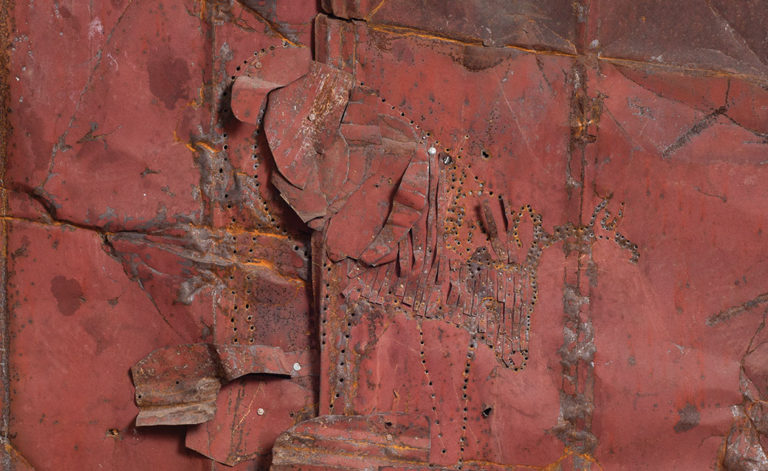
Ronald Lockett was a Black artist who lived in Bessemer, Alabama. He knew he wanted to be an artist even when he was a child, and his uncle, artist Thorton Dial, mentored him. Lockett made his art by layering materials he found around him, including metal, wire and wood. These works of art look like landscapes without any people or buildings. Lockett was interested in showing pollution’s impact on the environment and his experiences feeling lonely where he lived. Take a close look at “Undiscovered.” What is the first word that comes to mind as you observe the work of art?
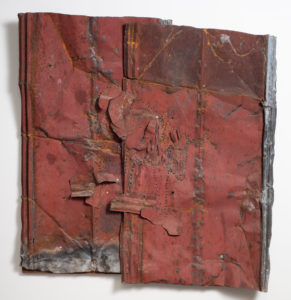 Ronald Lockett (America, 1965 – 1998), “Undiscovered,” 1993. Rusted tin and colored pencil mounted on wood. Georgia Museum of Art, University of Georgia; Gift of Ron and Jun Shelp. GMOA 2019.309.
“Undiscovered” shows a deer made of metal pieces and small hole punches. Can you find it? The animal looks like it is walking down a rocky trail. Lockett’s art frequently shows deer or buffalo. He felt these animals represented him and his feelings about his life. What animal do you think represents you? Why did you pick that animal?
In this activity, you’ll layer torn pieces of paper to create an animal that symbolizes you.

For this activity you will need:
- construction paper
- glue
- markers
To make your torn paper animal:
- Think about an animal that is meaningful to you. It can be your favorite animal or an animal that represents a part of your personality — like a brave lion or a silly penguin.
- Tear large pieces of paper into the shape of the animal. Glue these on another piece of paper that will be the background.
- Add details to your animal by ripping more pieces of paper in different colors and layering them onto your work of art. Does it have bright stripes? A flowing mane or a sharp beak?
- Use markers to draw the animal’s face.
- Try adding more pieces of paper to the background to create an environment for the animal. Where does it live?