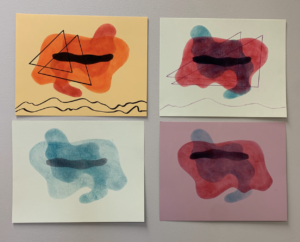
Artist Raymond Jonson co-founded the Transcendental Painting Group. These painters wanted to create paintings without any recognizable forms. In his painting “Watercolor No. 8,” Jonson uses airbrushed watercolor to create crisp shapes and lines. What do you notice about the shapes and lines in this work of art?
Jonson worked in a variety of media throughout his career. His work became more and more abstract. He originally made colorful portraits, then moved onto surreal nature scenes and then to works like this one, which does not look like anything in nature or reality.

Raymond Jonson (American, 1891 – 1982), “Watercolor No. 8,” 1942. Watercolor (airbrush), 24 1/2 × 31 1/2 inches. Georgia Museum of Art, University of Georgia; Promised gift of Michael T. Ricker.
For this activity you will need:
- paper
- cardboard or cardstock
- scissors or an x-acto knife
- paintbrush
- ink pad
- paper clips
- Marker or colored pencil
To Make Your Porchoir Shapes:
- Think about what shapes you would like to create. Are there any shapes and colors that stand out in the world around you?
- Make stencils by cutting shapes out of the inside of each piece of cardstock or cardboard. Make shapes of different sizes. How will they look layered on top of each other?
- Place a shape on the paper. Use paper clips to hold the stencil in place. Press the brush lightly on the ink pad, then begin gently brushing color into your stencil. Tip: Start brushing from the edge of the stencil and brush inward onto the page to avoid accidentally lifting the stencil. This also creates a smoother texture!
- Repeat for your other shapes.
- Complete your pochoir piece by adding lines with a colored pencil or a marker. You can make triangles like in Jonson’s piece by using the flat edge of the cardstock, or you can draw any lines and shapes you want! How many different lines and shapes can you include in one work of art? Try using the same stencils with different color ink.