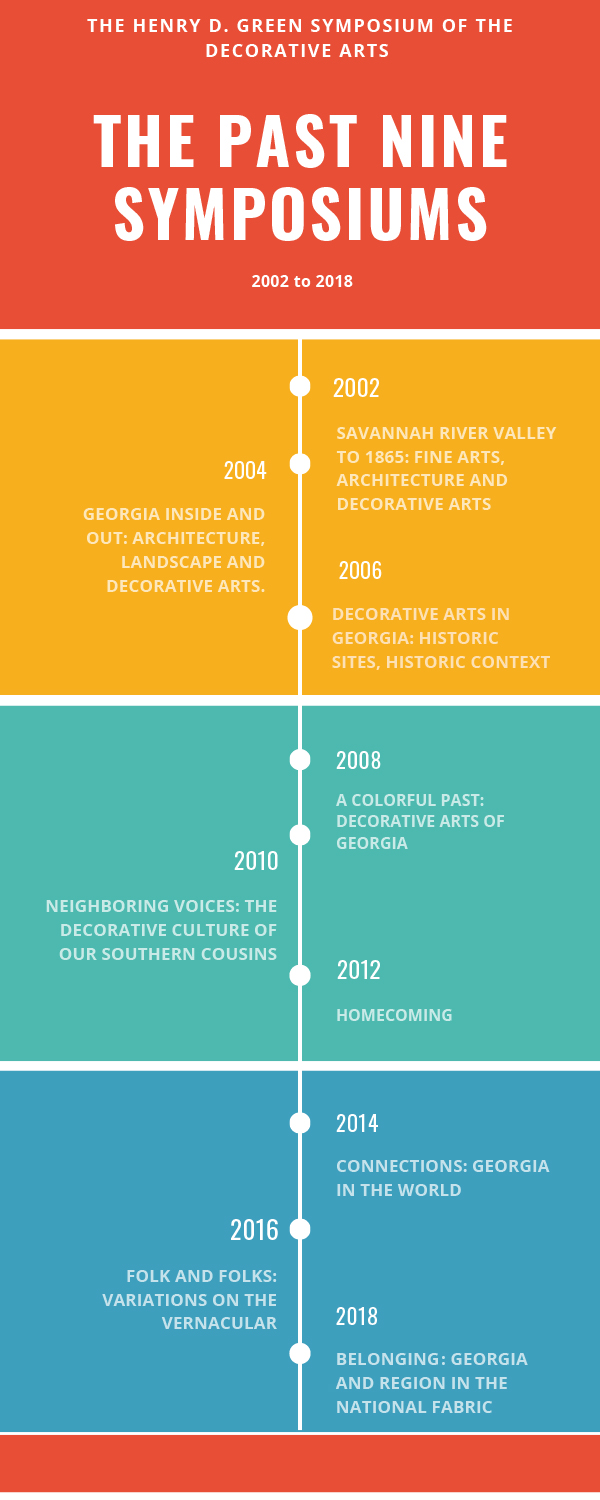
A timeline of the 9 previous symposiums
On January 25 – 26, 2002, the inaugural Henry D. Green Symposium of the Decorative Arts “The Savannah River Valley to 1865: Fine Arts, Architecture and Decorative Arts” brimmed with more than 400 participants at the Georgia Museum of Art. Since that weekend almost 18 years ago, the Green Symposium has blossomed into one of the largest events dedicated to material culture, and its reach has spanned thousands of attendees.
This year marks the 10th symposium (held every other year) and the 20th anniversary of the Henry D. Green Center for the Study of Decorative Arts. These two overlapping anniversaries are not only a time to reflect on the perseverance of the two programs, but a time to highlight the progressive volumes of scholarship and groundbreaking exhibitions amassed since their conception.
“We are able to not just teach about culture and people and identity, demographic groups and ethnicity, we are also able to look at stereotypes in American decorative arts and material culture and change those as well,” Dale L. Couch, curator of decorative arts at the museum, said of his work on the Green Symposium and the Green Center exhibitions since 2010.
During this year’s symposium(opens in new tab) “Georgia Matters: Celebrating Two Decades of Scholarship,” on January 30 – February 1, 2020, visitors can expect presentations by scholars from within Georgia and beyond. Attendees will hear presentations on Georgia portraiture, colonial Georgia silver, Masonic symbolism in Georgia, porcelain decoration, historic preservation on the UGA campus and other new scholarship.
The exhibition “Material Georgia 1733 – 1900: Two Decades of Scholarship”(opens in new tab) is on view until March 15, 2020. This exhibition is home to the largest group of 18th-century Georgia furniture exhibited to date. It also weaves in silver, pottery, textiles, basketry and portraits to tell a diverse history of Georgia’s textured past. This collection shares its name with the accompanying catalogue(opens in new tab) the museum published for it, and it was designed as the exhibition component of Georgia Matters.
“The biggest milestone is this exhibition because it has brought all those earlier works into play and I think it will help define scholarship moving forward,” Couch said.
The previous nine symposia debated and discussed an array of topics. From silver to rifles, the material culture of the South has been breathed new life by this event and its overlapping exhibitions. From Fall 2005 to Spring 2006, the exhibition “From Sideboard to Pulpit: Silver in Georgia” was on view in conjunction with the third Green Symposium, “Decorative Arts in Georgia: Historic Sites, Historic Context”. This exhibition “spearheaded and redefined gains in the study of Georgia silver,” Couch writes in “Material Georgia.”
In 2015, concurrent with the 8th Green Symposium, “Folk and Folks: Variations on the Vernacular,” the exhibition “Georgia’s Girlhood Embroidery: Crowned with Glory and Immortality”(opens in new tab) brought this craftsmanship to a higher level within the state and beyond. More recently, in 2017, the exhibition “Artful Instruments: Georgia Gunsmiths and Their Craft”(opens in new tab) was on display in the at the museum and discussed at 9th symposium, in 2018, “Belonging: Georgia and Region in the National Fabric.” This exhibition on Georgia-made longrifles was the first of its kind in the state.
For 20 years, the Henry D. Green Center for the Decorative Arts at the Georgia Museum of Art has been a driving force in the study and preservation of material culture within Georgia and the South, and its biennial symposium has showcased milestones within southern material culture.
“We want discussion, we want debate, we want other and newer interpretations,” said Couch, whose hope for the upcoming symposium and the current exhibition is for people to engage with the diverse works display, creating momentum toward future milestones.