As 2023 comes to an end and we look forward to the new year ahead, it’s also a good time for reflection. The year was noteworthy in the history of the museum and was marked by change and celebration of what the Georgia Museum of Art is today, its founding principles and what the future holds for the institution in the years ahead. Let’s take a look at some of this year’s big moments and accomplishments.
Top Reads
If you’re reading this post and aren’t a regular visitor to our blog: welcome! The blog is updated weekly with content that is researched and reported by staff, including me and our director of communications Hillary Brown, but also by student interns. What were this year’s top reads? Check out the list below:
2. Get to Know Our New Director
4. A Transitional Decade: Georgia Museum of Art in the 1970s
5. Elegant Salute XVII Raises More than $430,000
6. Student Intern Appreciation: 2022-2023 Interns
8. Museum Welcomes Mallory Lind as Assistant Curator of Education
9. The South Got Something to Say
10. Howard Thomas’ “Little Grand Canyon Yellow” Is Back on View
On View
This year, the Georgia Museum of Art’s galleries were graced with more than a dozen thoughtful and unique exhibitions that challenged perceptions, prompted discussions and offered many a source of inspiration. Well-loved by visitors, according to guest feedback, the museum’s exhibitions were also applauded by art critics and other notable figures in the art world. What exhibitions stood out this year as particularly noteworthy?
Reckonings and Reconstructions: Southern Photography from the Do Good Fund
This exhibition closed just eight days into the new year, but it set the stage for a year of exhibitions that examined and challenged the idea of the South, with all of its complexities and contradictions. Read or listen to WABE’s interview with the curator of the exhibition and relive the exhibition via a beautiful accompanying publication. Get your copy here.(opens in new tab)
Kristin Leachman: Longleaf Lines
Leachman’s “exhibition offered visitors an examination of longleaf pine forests and made quite an impact on visitors. Alongside the exhibition, the gallery guide and coloring book were a huge hit among our younger visitors.
Art is a form of freedom
Curated by our head of education, Callan Steinmann, in collaboration with Common Good Atlanta, this project brought the museum to a Georgia women’s prison and then reflected the learning experience of incarcerated women back to the museum gallery. The result? An exhibition that sparked discussion and debate about the value of art education as part of rehabilitation in the U.S. prison system. Jessica Smith, a writer who covers all things art for the Athens alternative weekly newspaper, Flagpole Magazine, puts it all into context in this feature article.
Object Lessons
“Object Lessons” featured four centuries of works from the Princeton University Art Museum that collectively explored American history, culture and society. Inspired by the concept of the object lesson — the study of a material thing to communicate a larger idea — the exhibition brought groups of objects together to ask fundamental questions about artistic significance, materials and how meanings change across time and contexts.
Southern/Modern
New York Times art critic Walker Mimms’ review praised the boldness of the exhibition’s presentation of an alternate history of modern art.
“These 100 or so paintings and prints suggest an invigorating direction that was there all along: a pungent pairing of social history with artistic experiment during the first half of the 20th century,” he wrote. “By bringing together professional artists who worked below the Mason-Dixon Line (exempting Florida) between 1913 and 1956, and as far west as Arkansas and Missouri, ‘Southern/Modern’ surveys the riches of a stylistic evolution you will find at, say, the Museum of Modern Art in New York — the Impressionism that loosened up the 1900s, the Cubism of the 1910s, the Surrealism of the ’20s, the modeled social realism of the ’30s, the feral abstractions of the ’40s and ’50s — as told by a region often buried in the art history books.”
The exhibition is moving on to Nashville this January, with a few other locations on tap following its Tennessee viewing. As the author notes, it’s an exhibition that deserves to be hosted in galleries well beyond the lines of the South.
Beyond the Norm
While the museum staff is proud of the many exhibitions hosted this year, 2023 was also marked by a lot of change and reflection. We celebrated 75 years as a museum with special events and a focus on our history thus far. UGA’s Special Collections Library hosted an exhibition about the museum’s history and other UGA campus media also helped us celebrate and revisit that history over the year.
Want to know more about the museum’s history? The UGA student newspaper, the Red and Black, produced a great feature about the museum and UGA Research’s in-depth feature on the museum is also worth a read. The museum blog explored the museum’s history decade by decade, with a feature each month. Start with the museum’s early days and make your way through the decades, complete with museum archives and newspaper sources. A close look at the museum’s evolution through the years sheds some light on the many artists and exhibitions that have been on view here, as well as our roots in becoming a trusted art establishment today.
Farewell and Hello
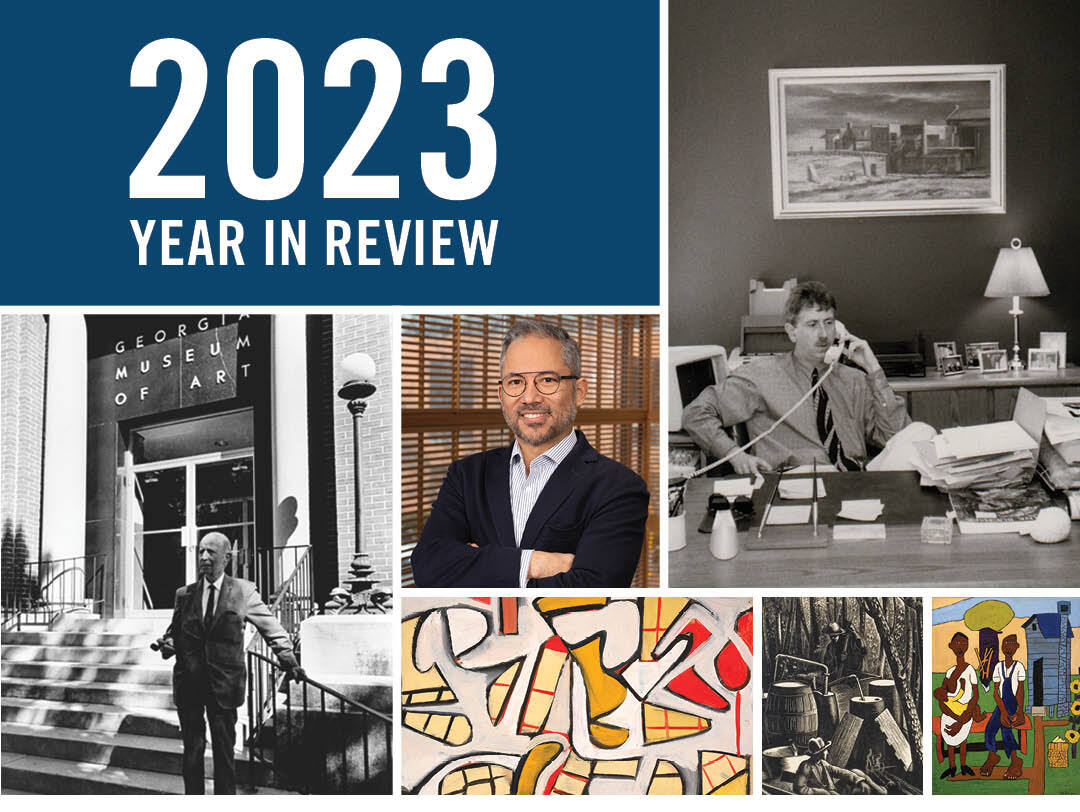
This year was also marked by a lot of change at the museum. William Underwood “Bill” Eiland, who was at the helm as director for the last 30 years, retired this year. He was celebrated at the biennial gala, Elegant Salute. He was also featured in the quarterly newsletter’s feature on philanthropy, in a piece that gives a nod to just how much he helped the museum grow.
It is no coincidence that the museum grew so much with Bill as its director for 30 years. His grand vision for what it could be and his ability to charm others into funding those ideas and transforming them into reality are perhaps his greatest legacy here.
On the heels of his departure, the museum also welcomed a new director. David Odo, who came to the Georgia Museum of Art from Harvard Art Museums, has been in his role for about half a year now and staff and the community have welcomed him with open arms, he noted in his director’s note in the upcoming issue of Facet, due out in January. Museum staff are looking forward to what is ahead for 2024 and to seeing our many supporters, guests and patrons in the new year. Until then, savor the end of this year and know that the museum is always here for a source of inspiration and community.
Authored by:
Jessica Luton