Let me preface this by saying that I love Bette Midler. I love her brass, her sass, her humor, and the way she squares up against the world and dares it to come after her. She’s wonderful.
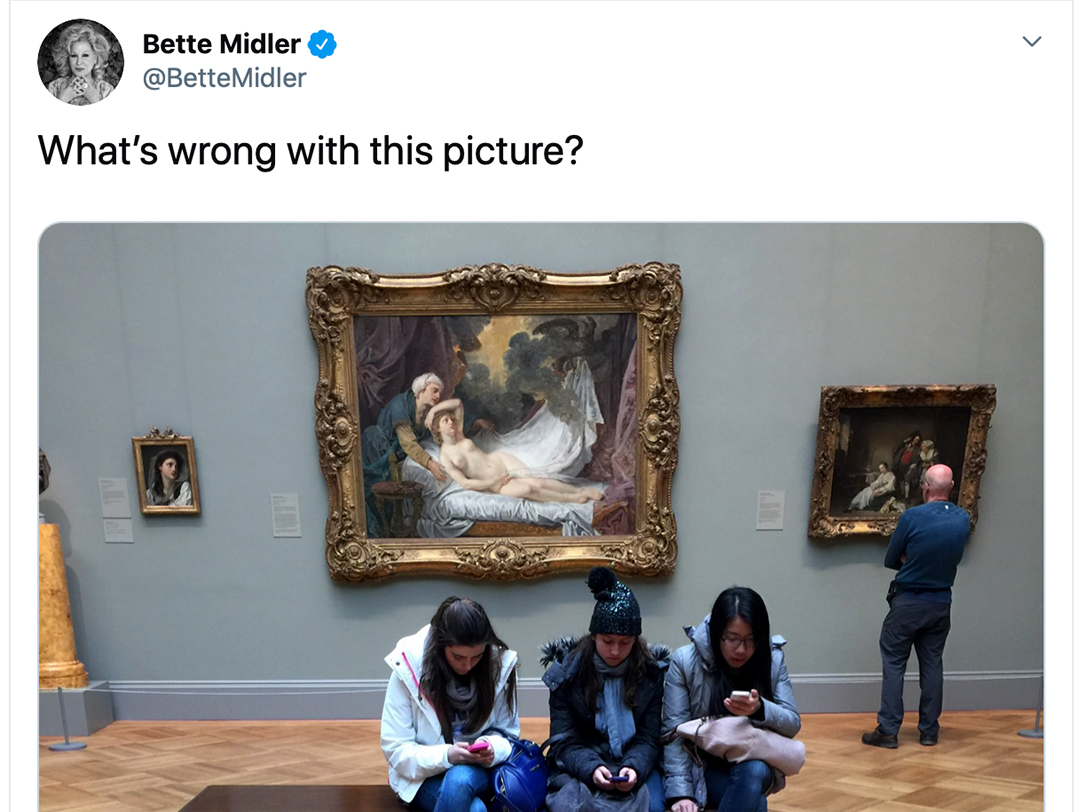
That said, nobody is correct all the time. On December 8 Ms. Midler tweeted a picture of three young women seated on a bench in a gallery of the Metropolitan Museum of Art, all three staring at their phones and seemingly ignoring the art on the wall. “What’s wrong with this picture?” the tweet exclaimed.
The clear implication was that the three young women were indifferent to the great works of art on display because the women are too absorbed in their phones. The tweet alludes to common but spurious stereotypes of modern youth, more specifically how they are supposedly obsessed with phone apps and the internet while failing to appreciate the world around them.
As much as I love Ms. Midler, I simply do not agree. As a museum professional, I would like to say that there is nothing wrong with this picture. People are free to choose whatever level of engagement they like with a museum. Some visitors want to study the art or make new discoveries, but others just want a quiet place to sit down for awhile to escape from the bustle of daily life. As far as we’re concerned those motivations are all completely legitimate. I guarantee you that whatever the purpose of your visit may be, museums are happy that you showed up.
Since Midler’s tweet I have been informed that this picture is a couple of years old and the young women were actually using the Met’s phone app to get more information about the displays. That’s all well and good, but it’s actually beside the point. Even if those three were sitting there texting their friends and watching cat videos, their visit was still entirely rightful and welcome.
In closing, there is no right or wrong way to visit a museum. You can come explore the art or you can drop by to simply grab a few peaceful moments in a calm and pleasant environment. In our eyes all visitors are equal and all are equally welcome. You’re not here for us; we’re here for you.
By Mike Dean