As the semester comes to a close, students are busy hunkering down for final exams. Off campus, others in the Athens community are navigating busy holiday social calendars, shopping for gifts, readying for holiday visitors and everything else that coincides with the last weeks of the year. Especially at this time of year, life can be overwhelming. Need a break for a few hours? The Georgia Museum of Art’s galleries are a peaceful oasis to escape and take a break from the everyday.
Whether you’re in need of solace or looking for activities to entertain holiday visitors, the museum has a wealth of works that are well worth a visit. Here’s a sampling of what the museum has to offer this month.
First on the list is the exhibition “Southern/Modern.”
Don’t delay if you’ve been meaning to check out this exhibition. It closes on Sunday, December 10. Late last month, the New York Times applauded it and gave it a critic’s pick designation. Critic Walker Mimms noted the exhibition’s bold retelling of an alternate history of modern art.
Of the many strengths of “Southern/Modern,” a daring and revisionist show about the American South at the Georgia Museum of Art in Athens, the one that follows you out to your car is the alternate history of modern art it proposes.Southern art — or food or literature, for that matter — has long suffered a reputation of isolation. “You cant understand it. You would have to be born there,” says the tortured Quentin in William Faulkner’s “Absalom, Absalom!” Ninety years later, Southern exceptionalism is over (mostly), and the area’s artists and curators and chefs now go to great, overcorrective lengths to be global, to be modern. But the artists of Faulkner’s day — they were still responding to an ancient, haunted South. Their audience was stationary, and their language local. They were regionalists. Or so the story goes.Not here. These 100 or so paintings and prints suggest an invigorating direction that was there all along: a pungent pairing of social history with artistic experiment during the first half of the 20th century. By bringing together professional artists who worked below the Mason-Dixon Line (exempting Florida) between 1913 and 1956, and as far west as Arkansas and Missouri, “Southern/Modern” surveys the riches of a stylistic evolution you will find at, say, the Museum of Modern Art in New York — the Impressionism that loosened up the 1900s, the Cubism of the 1910s, the Surrealism of the ’20s, the modeled social realism of the ’30s, the feral abstractions of the ’40s and ’50s — as told by a region often buried in the art history books.
“This is a model exhibition: a targeted provincial study of the innovations we too often associate with Paris and New York,” he notes later in the piece. “It will be relevant to the many Northern institutions that house these artists (several appear in the Met’s current collection show on the Depression, “Art for the Millions”).” As the exhibition picks up and travels to new destinations, including Nashville, Charlotte and Memphis, in the coming months, Mimms laments that the exhibition is not traveling further north.
Another great exhibition on view this month is “Nancy Baker Cahill: Through Lines.”
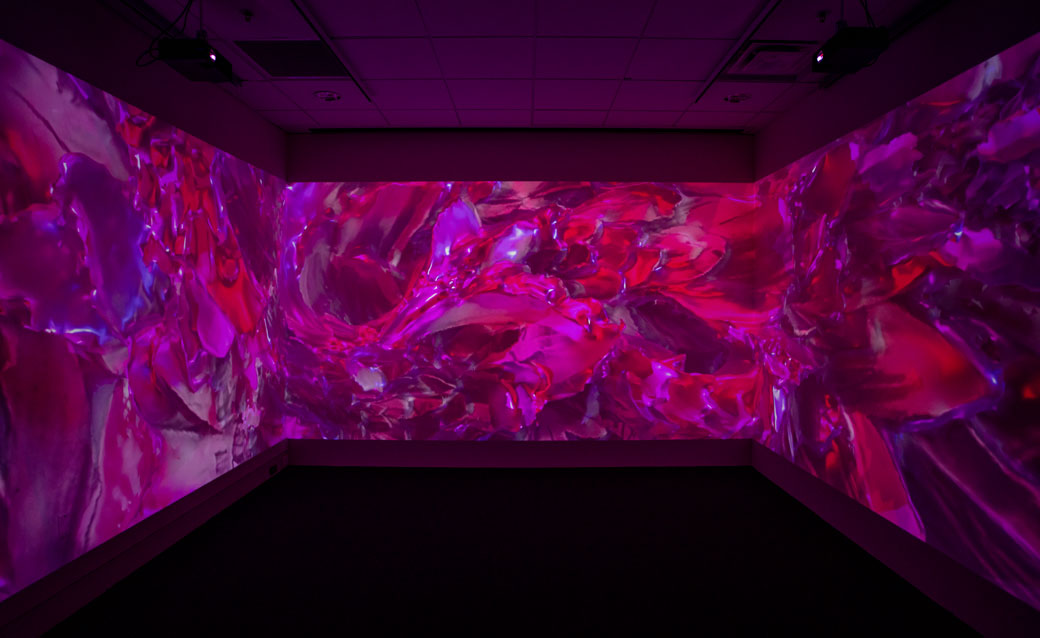
One of the museum’s newest opening exhibitions offers a unique glimpse of artist Nancy Baker Cahill’s version of reality. Walk through the museum’s Jane and Harry Willson Sculpture Garden and you could easily walk straight through “Margin of Error” without realizing it. Baker Cahill’s augmented reality (AR) art installation is only visible by looking through the artist’s free AR app 4th Wall. Inside, more of the artist’s AR work is on view in the galleries. Together, the works in “Through Lines” are a mid-career survey of the artist’s work and her first solo exhibition.
“Expanding upon her background in traditional media, the artist redefines the possibilities of drawing in contemporary art. She begins with finely rendered graphite drawings that evolve into torn paper sculptures, then scans and animates them into 3D digital immersive videos. The drawings, altered by software, later reappear as single cinematic frames in the form of fine art prints. “Through Lines” moves across spatial dimensions and media, following Baker Cahill as she investigates materiality and immateriality through her progression from drawing into digital works of art in AR. Featuring drawings, sculptural installations and single- and multichannel videos, the exhibition traces Baker Cahill’s mark-making from traditional modes of artistic production into technologized ones. The works invite reconsiderations of fine art and the art historical canon in the face of emerging technologies while examining site, time and space as they relate to the physical body, the digital, the permanent and the ephemeral.”
As Rough Draft Atlanta notes:
Baker Cahill’s early artworks began with experimentation, transforming abstract graphite drawings into 3D digital renderings that were suggestive of organic forms. More recent works take that concept one step further, in her process she starts with 2D artworks that she then deconstructs and reinterprets into virtual reality and augmented reality artworks.“For me the connection between drawing and video makes perfect sense (witness Paleolithic cave paintings which paired drawing and flickering light), but it wasn’t until I began drawing in virtual reality (VR) that I think I fully connected the essential entanglement of both forms in my practice,” said Baker Cahill.
Stroll through the museum’s Jane and Harry Willson Sculpture Garden to view the AR work “Margin of Error.” Through the artist’s 4th Wall app, which she created as a free AR art platform for her works, viewers trigger an AR experience by scanning the sign in the garden.
“Margin of Error,” imagines an inevitable and toxic outcome created by humans’ impact on the environment. The title references the statistical probability of an event to occur, in this instance the occurrence of environmental disaster. By placing this work in the museum’s sculpture garden, the exhibition underscores the consequence of the impending biological, chemical and geological disasters that will take place in our own backyards.
In the gallery, Baker Cahill’s prints “Slipstream 17” and “Slipstream 18” trigger their own AR animations, bringing static images to life as related videos. The artist’s AR works bridge the physical and virtual worlds . . . allowing viewers to interact with and document themselves with the work.
Through their visceral and temporal qualities, Baker Cahill’s AR works help viewers visualize what philosopher Timothy Morton calls “hyperobjects”: entities of such monumental scale and complexity that they often defy conventional modes of human understanding. By rendering the invisible visible, the artist challenges perception and reveals the unmarked, untold and unimagined.
This exhibition at the Georgia Museum of Art is one of only a few the artist has done within the confines of a museum. Focusing on specific landmarks, locations and/or associated cultural issues, her most recent works are immersive art installations that are jarring, thought provoking and inspiring.
Early in 2023, for instance, her work “State Property” projected an exploding uterus above the Supreme Court and other state houses that was only visible using her AR app. Before the Georgia Museum of Art exhibition opening, the artist unveiled a new work that unleashed “a surreal interspecies creature on the terrace of the Whitney Museum.” In 2020, another work, “Liberty Bell,” sparked debate about the nature of public art and history. The writer of a New York Times feature article about her work and her use of augmented reality to explore the meaning of historical sites went so far as to question “whether public art was embellishing our heritage or defacing it?”
The exhibition offers a unique look at the artist’s evolution through experimentation in her career.
“Experimentation has led to many creative breakthroughs in my work,” explained Baker Cahill of her art process to Rough Draft Atlanta. “To me, experimentation involves play in the sense that one plays with media, with subject matter, with traditional approaches, in order to generate new methods, perspectives and outcomes.”
The exhibition is on view through May 19, 2024.
Need more museum events to escape from the stresses of the month? Check out our calendar.
Of note: Third Thursday and Yoga in the Galleries on Dec. 21; Tour at Two on Dec. 13, Dec. 20 and Dec. 27 and a Sunday Spotlight Tour on Dec. 17.
Authored by:
Jessica Luton