Ukraine has been in the news a lot lately. If you’re looking to learn more about this country through the perspective of its visual art, the Georgia Museum of Art is offering an upcoming opportunity. The museum and the University of Georgia’s Lamar Dodd School of Art will host a symposium on Ukrainian art March 27 and 28. The symposium’s goal is to investigate Ukraine’s cultural and political history through three different exhibitions on the University of Georgia’s campus. Each exhibition provides a unique and interpretive view of the cultural history of Ukraine — whether through socialist realist paintings, costume drawings or ceramic sculptures — to offer context for the current Russo-Ukrainian War.
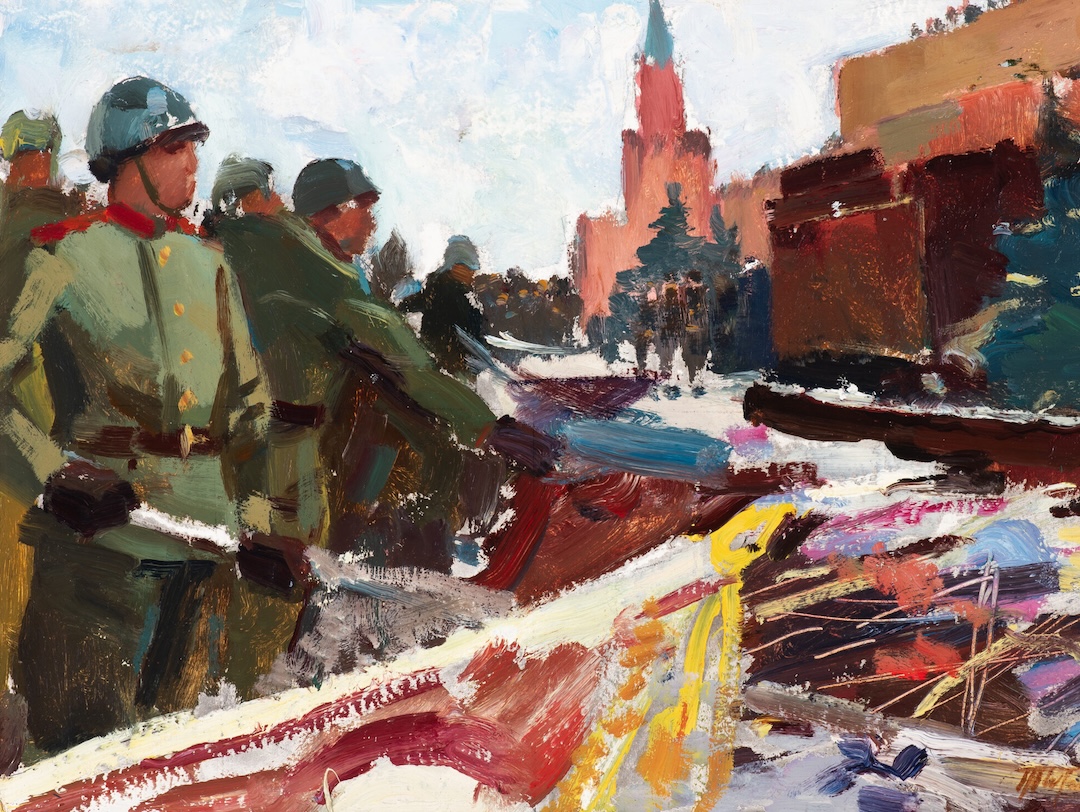
Currently on view at the museum through June 1, “The Awe of Ordinary Labors: 20th-Century Paintings from Ukraine” features paintings from 20th-century Ukrainian artists made during the Soviet era. Asen Kirin, professor of art history at Lamar Dodd and Parker Curator of Russian Art at the museum, served as curator of the exhibition. Soft lighting welcomes people as they make their way into the exhibition. It brightens as you get closer to each painting, inviting you to look for the alternative and subversive interpretations in many of the works. The exhibition’s purpose is to take a look at the belief that socialist realist style was just propaganda art. Instead, the featured paintings show subtle individualism, emphasizing a new perspective on this genre of art.
At the Lamar Dodd School of Art, two different exhibitions will be on view in the Foundation Gallery through April. In “Ukraine’s People Revealed,” people can view 18th-century hand-painted costume drawings from the Swedish National Museum, Stockholm. These images show the rich and established culture Ukraine had outside of Russian influence and control, providing a broad panorama of the distinct social structures of the Ukrainian Hetmanate featured through the clothing of a nobleman to a peasant.
“Demons, Prophets, and Détente” is a ceramic sculpture installation by professor emeritus and current student Richard N. Johnson. Johnson began this piece on the day the Russians invaded Ukraine. He uses porcelain human and animal figures to represent Ukraine and Russia, creating allegorical portrayals of political and human failure. Johnson crafted porcelain tiles and inscribed the names of towns and cities being overrun by Russian forces, later adding previously annexed towns in Crimea. Demons, representing the Russian forces, are black with tinges of blood red, while Ukrainian prophets are multicolored and lighter.
Key events at the symposium include an opening lecture by Nathaniel Knight (co-curator of “Ukraine’s People Revealed”), a keynote lecture by Myroslava M. Mudrak (professor emerita at the Ohio State University) and presentations from graduate students in Dr. Kirin’s ARHI 8400 seminar on socialist realism.
Each student in the seminar researched paintings or issues related to “The Awe of Ordinary Labors.” For example, Ivy Kolkana’s research focuses on portraits of women and ideological constructs in socialist realism, primarily examining Serafima Senkevich’s “Portrait of a Young Woman” and Leonid Bessaraba’s “Portrait of a Young Kolkhoz Woman.” Kolkana noted that “analyzing the portrayals of women by both male and female artists reveals that while feminine attributes were not entirely eliminated, they were redefined to align with the state’s ideological objectives.” MA candidate in art history Kristen Spiros added, “I am eager to share this research with a wider audience and help people understand the multilayered valence of these paintings. Although many of the works in the exhibition might appear understated and unremarkable at first glance, close looking and awareness of the historical context can help unearth a wealth of meaning.”
The symposium should offer fresh and diverse perspectives on Ukraine’s history and current war, showing the country’s distinct cultural and artistic heritage. The event is sponsored by the Willson Center for Humanities and Arts through a Public Impact Grant. All events are free and open to the public unless otherwise indicated. Visit the museum’s website for a full schedule.
Authored by:
Isabel Davis