Since 2018, the museum has made an effort to expand its collection to include more works of art from Eastern Europe. This expansion has allowed us to acquire forty-four paintings created by Ukrainian artists during the Soviet era, now part of the Maniichuk-Brady Collection(opens in new tab) and the Parker Collection(opens in new tab) at the Georgia Museum of Art. Beginning Saturday, January 18, visitors can explore them in our new exhibition, “The Awe of Ordinary Labors: 20th-Century Paintings from Ukraine.”(opens in new tab)
The featured paintings capture what is called the socialist realist style. This style is characterized by its optimistic pictures of Soviet life and Communist ideologies. Artists were supposed to show the endless battle of the working class against their oppressors. Art was to show not reality but ideals. These demands led to numerous works of Soviet art, including those produced in Ukraine, being purely political propaganda.
Nevertheless, many artists were able to navigate the margins of artistic freedom. “While not condemned or rejected by the official censors, [they] still conveyed highly personal content,” said Dr. Asen Kirin, the curator of this exhibition and the museum’s Parker Curator of Russian Art(opens in new tab). Kirin said that visitors can see these alternative and subversive interpretations within paintings in the exhibition, gaining new insights into the visual culture of 20th-century Central and Eastern European art.
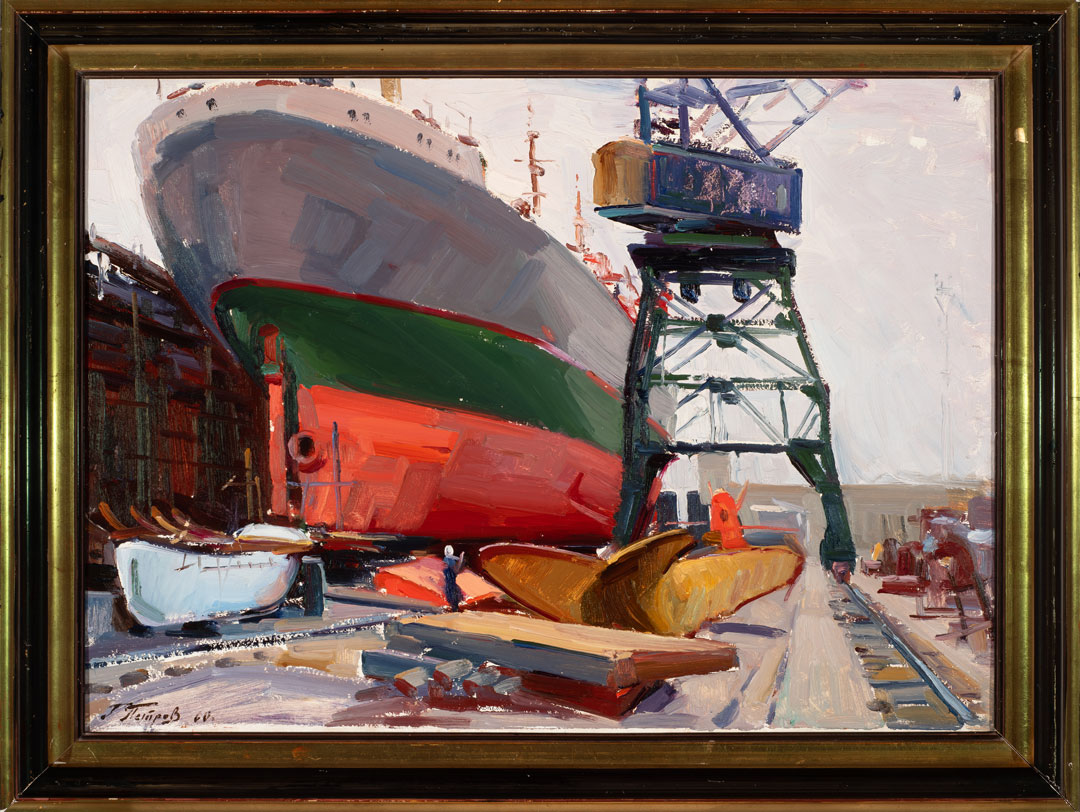
From landscapes to portraitures to still lifes, visitors can study visual richness and what Dr. Kirin calls “intensely human content.” A painting of a colossal ship stands at the entrance to the exhibition. One could see this work as propaganda for the economic progress of the Soviet Union but look closely and you might see a small person in the scene. This detail provides a deeper understanding of the effect of industrialization on individual lives, especially as industrialization was a top priority of the Soviet Union. As visitors walk around the gallery, they can look for these small details, whether through minute figures, color schemes or the depiction of light.
The exhibition includes contrasting artworks that emphasize either typicality or the fundamental desire to be an individual and express yourself as you see fit. For example, Leonid Bessaraba’s “Portrait of a Young Kolkhoz Woman” shows a stereotypical view of a strong and morally pure young woman embodying Communist ideology. In contrast, Serafima Senkevych’s portrait of a young woman feels like an individual, not a type.
“Socialist realism does not constitute an unchanging monolithic block of servile art. Artistic work evolved over time, and remarkable creative individuals left their unique imprints on the visual culture of that era,” said Dr. Kirin. These unique imprints are seen through visual references, as people in the Communist Bloc had limited access to the literature, art, music and cinema of the free world. The show includes several paintings that represent or refer to other works of art. For example, in Zinayida Volkovinska’s portrait of her daughter, she shows Picasso’s avant-garde portrait of his wife Jacqueline Roque in the background. Volkovinska’s portrait highlights the merits of artistic freedom as the subject carries a box of paints. By purposefully adding these Western references and replicating avant-garde works, these artists again emphasized individuality.
With war raging in Ukraine since 2022, numerous works of art, monuments and historic sites are facing destruction. Kirin called the exhibition a gesture of solidarity with the Ukrainian people and said, “In our modest way, we are striving to show wider audiences the richness of Ukrainian visual culture.” We hope that doing so will enable more outstanding works of Ukrainian painting from the 20th century to be restored, conserved and preserved for future generations.
This exhibition is sure to leave visitors reinterpreting their knowledge of life and art in the Soviet Union while also acknowledging the plight of the Ukrainian people as they continue to fight for independence. “The Awe of Ordinary Labors: 20th-Century Paintings from Ukraine” is on view January 18 – June 1 and should not be missed.
Authored by:
Isabel Davis