Thanks to the generous contributions provided by the Collectors of the Georgia Museum of Art, the museum continues to fill gaps in the permanent collection(opens in new tab). Overall, women artists, particularly those of color, require better representation nationally, therefore strategic purchases at our museum are one step toward mitigating such art historical inequities. Funding from the Collectors was used in 2017 to purchase a sculpture by 19th-century artist Edmonia Lewis, yet two recent purchases focus on contemporary artists Jennie C. Jones and Bethany Collins.
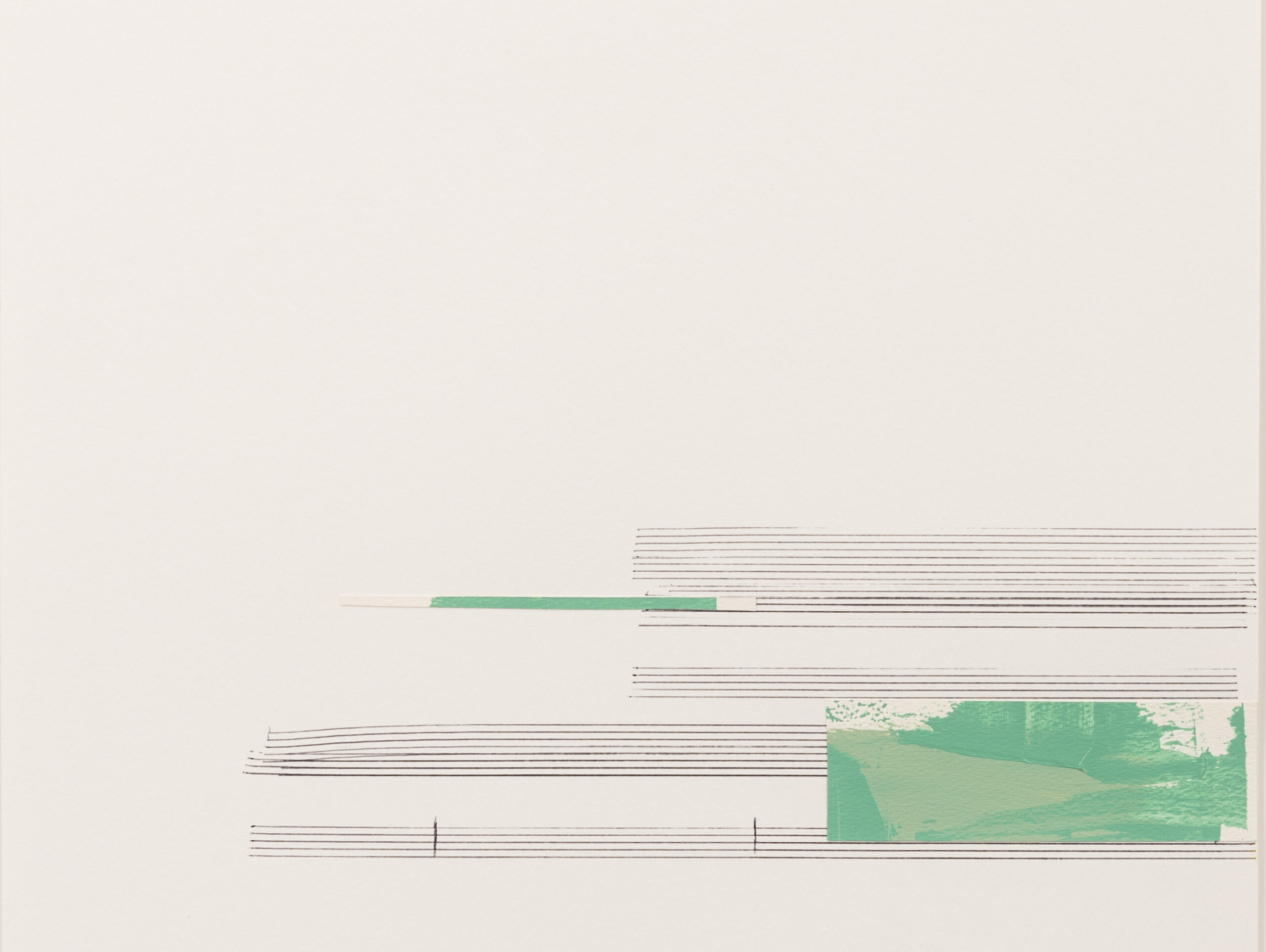
New York-based artist Jennie C. Jones melds visual and sonic traditions and their relationship to the history of minimalist abstraction. Viewing “listening as a conceptual practice,” her work often presents pairings of visual and sound traditions for audiences to consider the interplay between aural environments and the visual experiences. Recent acquisitions include two collages based on a commissioned installation at the Philip Johnson Glass House (1949) and Sculpture Gallery (1970). Phillip Johnson (1906-2005) was a major figure in 20th-century architecture and these two structures are located on the tranquil grounds of his 49-acre property in New Canaan, Connecticut, which is a national historic site. Jones infused the spaces with meditative solfeggio frequencies which gradually change to avant-garde jazz compositions as visitors move through the spaces, reflecting the social and cultural shifts occurring between 1949 and 1970. The collages, in effect, become a visual record of these experiences.
Bethany Collins, a native of Montgomery, Alabama, working in Chicago, uses textual sources as a way of interrogating America’s racial history through her conceptual practice around language. She often manipulates books and documents to overturn their authoritative strength in the lives of marginalized communities. The Georgia Museum of Art’s recent acquisitions are drawn from works in an installation called “The Southern Review” where she alters pages from the literary journal of the same name that was active in the 1980s. Collins blackens out the body of each page with charcoal, often leaving provocative titles and other isolated text and her own fingerprints to represent omitted narratives of Black and “othered” individuals from southern history.
Authored by:
Shawnya Harris