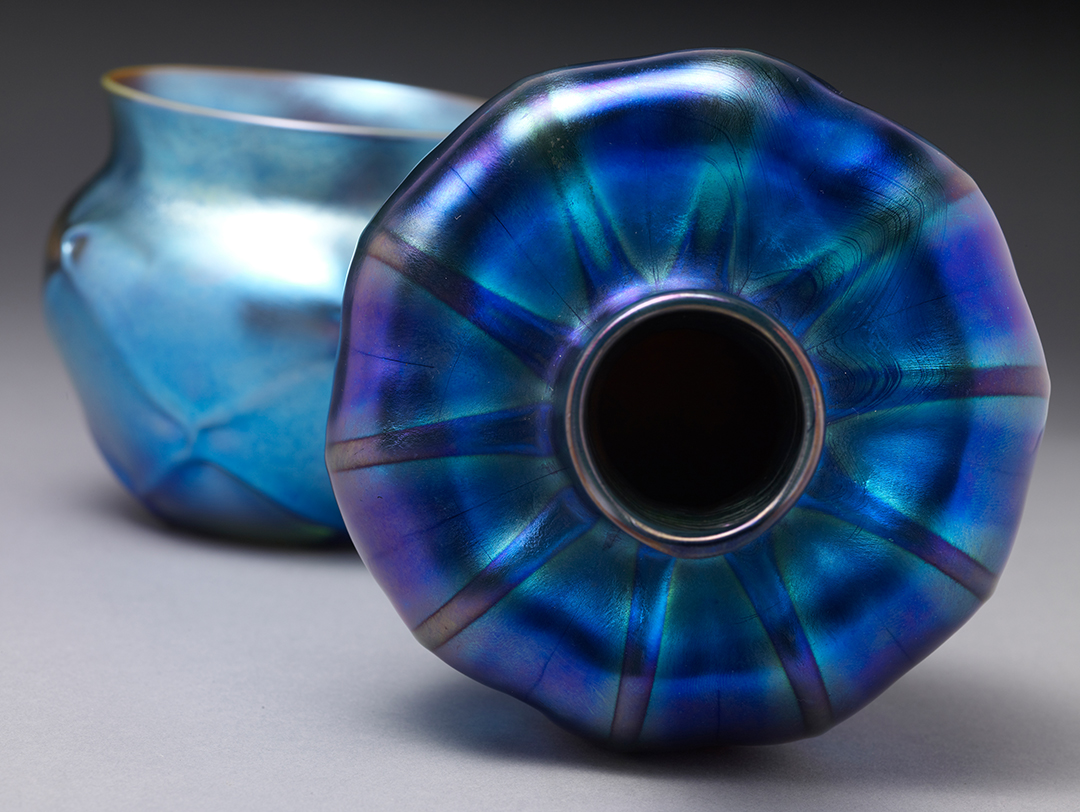
“Louis Comfort Tiffany: Treasures from the Driehaus Collection” will be on display at the Georgia Museum of Art from February 1 to May 10, 2020. This collection features works in multiple forms, including windows, lamps, accessories and more. At the heart of this creative operation was a Louis Comfort Tiffany- the eldest son of Tiffany & Co founder Charles Lewis Tiffany. Instead of joining the family business, Tiffany took to studying fine arts. By the late 1870s, Tiffany’s work shifted to the decorative arena, leaving hardly any medium untouched.
Tiffany made his mark during the Aesthetic Movement, an era inspired by historic art from Asia, Europe, Africa and the Islamic world. He also used an unusual approach to art by including an abundance of color, light and texture. However, he disapproved of the traditional methods of glass painting, so he created a new process which produced iridescent finishes, lava glass and Favrile glass. In describing his work Tiffany said, “God has given us our talents, not to copy the talents of others, but rather to use our brains and imagination in order to obtain the revelation of true beauty.” This is shown in the art that he chose to produce. He also decorated his own spaces including his home, Laurelton Hall, in 1905. It was donated to his foundation after his death and turned into a school for artists. Although it was destroyed in a fire in 1957, Laurelton Hall was considered an exemplar of Tiffany’s aesthetic.
By the 1880s, the Tiffany Glass Company was the largest producer of stained-glass windows in the nation, which made their bankruptcy in 1932 all the more surprising. Although Tiffany continued to be innovative in his later works, the 1930s saw a shift away from Art Nouveau styles towards a more minimal aesthetic, leading to a significant decline in the business. The appreciation that Tiffany had gained during his lifetime dwindled by the time of his death on January 17, 1933, and it wasn’t until the late 1950s that his company’s work was rediscovered and commended.
Deputy director Annelies Mondi says, “It is with great pleasure that we are able to bring the exhibition Louis Comfort Tiffany: Treasures from the Driehaus Collection to our audiences here at the Georgia Museum of Art. This impressive array of objects from stained glass windows and lamps to blown glass vases and metal work exemplifies Tiffany’s eye for elegance and beauty along with his accomplished craftsmanship. His ability to capture the sublime magnificence of nature and to imbue everyday objects with grace is evidence of his creative and technical mastery. It is our hope that visitors will not only learn about Louis Comfort Tiffany but also experience the awe that can arise from viewing something beautifully designed and made.” Along with the exhibition the museum will host multiple decorative arts events:
• The 10th Henry D. Green Symposium of the Decorative Arts: “Georgia Matters: Celebrating Two Decades of Scholarship,” at the UGA Hotel and Conference Center from January 30 to February 1, 2020.
• A keynote speech by Daniel Ackermann at the Symposium of the Decorative Arts on January 30 at 5:30 p.m.
• 90 Carlton: Winter, the museum’s quarterly reception, on January 30 from 5:30 to 7:30 p.m. (Free for current members, $10 for Friends of the Museum and Supporters, $15 for Not Yet Friends; galleries open until 8:30 p.m.)
• A glass mosaic workshop on February 8 from 1:00 to 4:00 p.m. (Registration is required; please call 706.542.4883 or email madison.hogan@uga.edu to reserve a spot.)
• A public tour with Annelies Mondi, deputy director and in-house curator of the exhibition, on February 18 at 2:00 p.m.
• A Toddler Tuesday on March 17 at 10:00-11:00 a.m. (Space is limited; please call 706.542.4883 or email madison.hogan@uga.edu after February 1 to reserve a spot.)
• Art Cart (After Class), a drop-in program for children, on March 18 at 3:00-4:00 p.m.
Authored by:
Giselle Brannam