The Georgia Museum of Art’s mission to make art engaging and accessible to all audiences isn’t confined to Athens; it reaches the whole state. The museum and independent guest curator Didi Dunphy are presenting “Seams to Be: New Approaches to Textile Techniques,” the fourth installment of “Highlighting Contemporary Art in Georgia,” a series of triennial traveling exhibitions that aim to make contemporary art accessible to large and small communities across the state. This chapter focuses on textile artists who are transforming traditions of craft while celebrating the labor of handwork.
“The fourth installment in this series explores experimental textile techniques through a curatorial lens. This dynamic area of artistic practice is bringing fresh innovations to the art world,” Dunphy said. “With needle and thread, the artists featured in this exhibition highlight the intricate labor and creative craftsmanship that define their work.”
The 13 artists featured in this exhibition, five of whom have or are pursuing a master of fine arts degree from the University of Georgia’s Lamar Dodd School of Art, display a tremendous range of technique, style and purpose.
Sonya Yong James is an Atlanta-based multidisciplinary artist who uses traditional techniques to create “new worlds of imagination” out of thread, horsehair, repurposed cloth and found objects. Her work varies in size and scale, engaging the surrounding environment and creating sensory experiences that range from overwhelming to intimate. Many of her sculptures involve organic shapes, cascading strings, clusters of knots that create unique compositions and woven forms. James explores the idea of fiber art as “women’s work” by highlighting the strength it takes to clothe bodies and provide warmth. She contends that cloth is a ubiquitous material that is central to the human experience, and “women’s work,” by extension, is integral to human life.
Her current work focuses on the natural world and collectively shared mythologies and folk tales. This work examines how stories about power and relationships are “spun and woven,” how conflicting meanings are created out of those stories and themes of sexuality, memory and death.
Cathy Fussell is a fiber artist based in Columbus, Georgia, who specializes in creating art quilts. She makes her quilts using a method called “free-motion quilting” in which she hand-guides her machine and stitches three to four layers of fabric together at a time. Fussell draws from USGS maps, historical maps, the Webb and Hubble telescopes, microscopic images, stories and her imagination to explore the ideas of space, time, form, color and distance. Her quilts use vibrant colors, organic shapes and abstract compositions. Like James’ work, her quilts explore the perspectives of nature and humanity while subverting the devaluation of feminized work.
“Quilts are about history and art and politics and stories and patience and beauty and community and economics and place and expression and freedom and transition and family and warmth — and love. And they’re feminized and devalued. All that is why I’m so into quilts and quiltmaking. Plus, I just love to sew,” Fussell shared on her blog.
Kate Burke is an Atlanta-based artist who received her bachelor of fine arts degree in fabric design in 2016 with honors from UGA. Her work explores the intersections of contemporary spirituality and digital culture. Deconstructing her Southern Baptist beliefs led her to question “belief” itself and interrogate how beliefs and ideas are created and spread across digital platforms. Through her craft, she explores the relationship between physical reality and digital experiences and questions whether engaging with the internet is inherently spiritual.
She contemplates these ideas by creating mosaic pieces and tiles that she uses like pixels to define units of information and create meanings. Many of her works layer vibrant pixelated images over found objects, juxtaposing endless scrolling with nostalgia and intentional craft-making as she explores the ideas of religion, physical reality and digital ephemera.
Kelly Taylor Mitchell is an assistant professor of art and visual culture at Spelman College who lives and works between San Juan, Puerto Rico, and Atlanta, Georgia. Mitchell is a multidisciplinary artist who is devoted to slow, labor-intensive practices that have been passed down for generations and carry ancestral memory. Her work derives from ancestral origin points in the Caribbean and the American South, incorporating printmaking, papermaking, installations, performance, book arts, soft sculpture and textiles. Her textile work is beaded, hand-embroidered and richly colored.
Mitchell practices what she refers to as Diasporic mapping: exploring how plant matter, found textiles and spiritual objects connect peoples beyond biology and researching marronage, Sankofa and masquerade. As she explores these mythologies, she creates them with her work.
Adah Bennion is an interdisciplinary artist from central Utah who is currently a master of fine arts degree candidate at the Lamar Dodd School of Art. She works almost exclusively with used materials. Bennion gathers everyday materials from her community and dismantles them by hand to familiarize herself with their unique characteristics and form intentional, intimate relationships with them. She works with her hands in defiance of convenience culture and in reverence to traditions and rituals.
Her work, which blends craft and sculpture, explores the shifting roles of materials and technology and how they reshape our relationships to memory and tradition. Bennion takes objects apart and puts them together, using intricate beading and stitching to make them new while exploring the idea of decay. In her examination of time and materiality, she wonders how modern-day synthetic materials will fare against the test of time and shape a future world that is no longer anthropocentric (human-centered).
Trish Andersen is a fiber artist from Dalton, Georgia, “the Carpet Capital of the World,” who explores her roots through the process of tufting. She gathers fibers from sheep, fields and factory floors to create a variety of tactile experiences within her work and examine the ideas of community and self. She investigates the idea of personal origin — whether a way of being is hereditary and where the “authentic self” is hidden. Andersen’s floor mats weave brightly colored organic shapes into intricate designs with unique textures.
In tracing her roots, she explores the real and imagined boundaries that separate people and what possibilities emerge when those boundaries bleed.
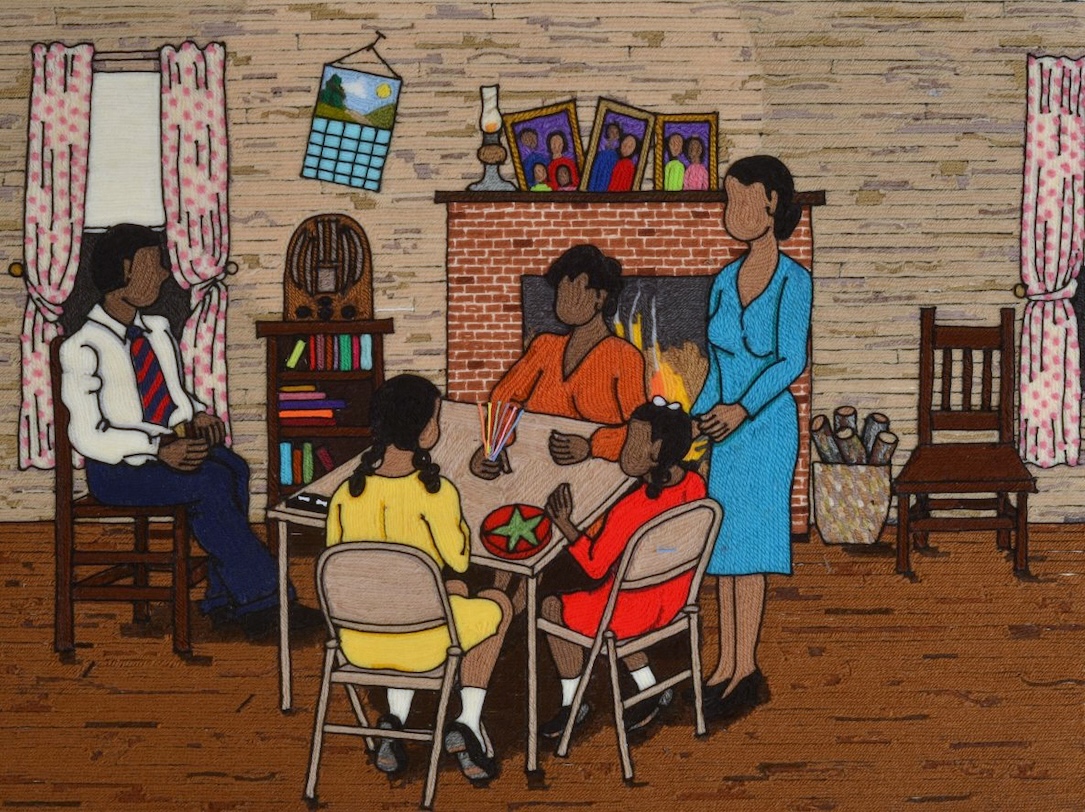
Annie Greene is a painter, craftswoman and retired educator from Georgia who is best known for her yarn paintings, richly colorful images of African American life created entirely out of yarn. Greene grew up in the segregated rural South, and her paintings reflect her life experiences. Her yarn paintings inspired her to chronicle her life in two autobiographical books: “Georgia Farm Life in the 1940s,” which compiles the stories depicted in her yarn paintings based on summers spent on her grandparents’ farm, and “What Color Is Water? Growing up Black in a Segregated South,” which details her life story from youth to desegregation. Though the scenes in her paintings may seem mundane, they are politically charged and socially relevant.
Honey Pierre is an Atlanta-based textile artist from Cleveland, Ohio. Her artistic journey began with a childhood fascination with fashion magazines that three years of military service reshaped. She tells stories with themes of identity, religion, culture and diversity by using the punch-needle technique to create vibrant, surreal images of Black and Brown communities.
She captures Black and Brown people in brilliant shades of blue, the color of liberation. By depicting different cultures of people as different shades of the same color, she highlights their shared experiences and their unity in their struggle for freedom. Her work celebrates marginalized peoples and invites viewers to connect with them emotionally. Like Annie Greene, her work highlights everyday moments in Black and Brown people’s lives and emphasizes the underlying resilience in the mundane moments of their mere existence.
Jamele Wright Sr. is an Atlanta-based multidisciplinary artist, curator and events producer from Ohio. After years of directing art, jazz and poetry events and curating a gallery called Neo Renaissance Art House, Wright embarked on his own artistic career. He works with found materials, Georgia red clay and Dutch wax cloth to create abstract textile sculptures that explore the Black American vernacular experience. His work draws from Black history and cultural influences to produce a dialogue around family, tradition and the spiritual relationship between Africa and the South.
Much of his work explores the idea of shifting energy through diasporic lineages or from one spiritual place to another as he gathers different cultural influences and channels them into his creations. Wright was inspired by the Great Migration of Black Americans who left their homes in the South in search of better lives. “This series operates as power items, assisting the user in moving from one physical, spiritual space to the next,” Wright shared in his artist statement.
Jasmine Best is a southern artist who uses a variety of fiber and digital art mediums. Best draws from her personal experiences and archival research to analyze how Black culture is co-opted by and absorbed into overwhelmingly anti-Black mainstream American culture. She explores the connections between the Black South’s folk story tradition and modern Black culture to contextualize how Black culture is documented and treated today.
Best approaches folk histories from a modern Black feminist perspective, questioning the narratives’ gendered implications and the gendered implications of the audiences and storytellers. She uses her fiber art to engage with the work of her female ancestors, to make folk stories tangible and to blur the lines between everyday life and mythology, all while encouraging audiences to interrogate their relationships to social capital, media and misogynoir.
Victoria Dugger is an Athens-based visual artist who dives headfirst into the nuances of her identity and experiences as a disabled Black woman living in the South. She reimagines the Southern Gothic through her own experience and creates figures that are exaggerated and elongated, feminine and opulent, tangled and decaying.
The distorted anthropomorphic characters that she creates are adorned with pearls, frosting and glitter. These characters, which represent her own body, explore what it means to be simultaneously invisible and hyper-visible. She allows the contradictory ideas of beauty and grotesqueness to blend in works that explore the desire, isolation and visibility inherent to performing femininity and performing to survive in a disabled Black body.
Jaime Bull is an Athens-based artist who currently teaches classes at UGA. Her art, which spans from drawings and paintings to sculptures and videos, focuses on oceanic themes from a humorous and feminist perspective. Her soft sculpture works are forms inspired by boats, sea creatures, mermaids and beaches that she creates by upholstering foam with sparkling fabrics. The forms that she creates are reminiscent of bodies that she “dresses up,” evoking feelings of nostalgia that make one want to love or squeeze them.
Eliza Bentz is a fiber artist and sculptor from Georgia’s barrier islands. She incorporates a variety of materials such as paper, wood and ceramics into her weaving practice while exploring the intersections of craft history and industrialization. She views her practice as a repetitive, meditative ritual that reestablishes her agency in a culture that is obsessed with convenience and immediacy. She refers to fabric as a gridded matrix in which material alchemy occurs: a space where something is created out of nothing.
As the weaver at the loom, she can create worlds out of nothing by engaging with the “innate haptic knowledge” of creation. The loom, she feels, is a ritual space in which she can create what she wants to see in the world by employing slow, meditative practices with her hands. In doing so, she embodies “her matrix” and it, in turn, embodies her.
Each of these artists draws from unique sources of inspiration to explore themes of culture, identity, time, materiality and tradition while defying societal limitations and driving innovation in the field of textile and fiber art.
“Seams to Be” opened at the Lyndon House Arts Center on October 2 and will remain on view until January 24, 2026. Dunphy and select artists will discuss the exhibition during a program on October 16 at 5:30 p.m. The exhibition will then spend nearly two years traveling to the LaGrange Art Museum (February 20 – April 11, 2026), the Morris Museum of Art in Augusta (May 2 – July 11, 2026), the Museum of Arts and Sciences in Macon (August 2 – December 12, 2026), the Albany Museum of Art (January 21 – April 24, 2027) and the Columbus Museum (May 20 – September 19, 2027).
Authored by:
Nabiha Rahman