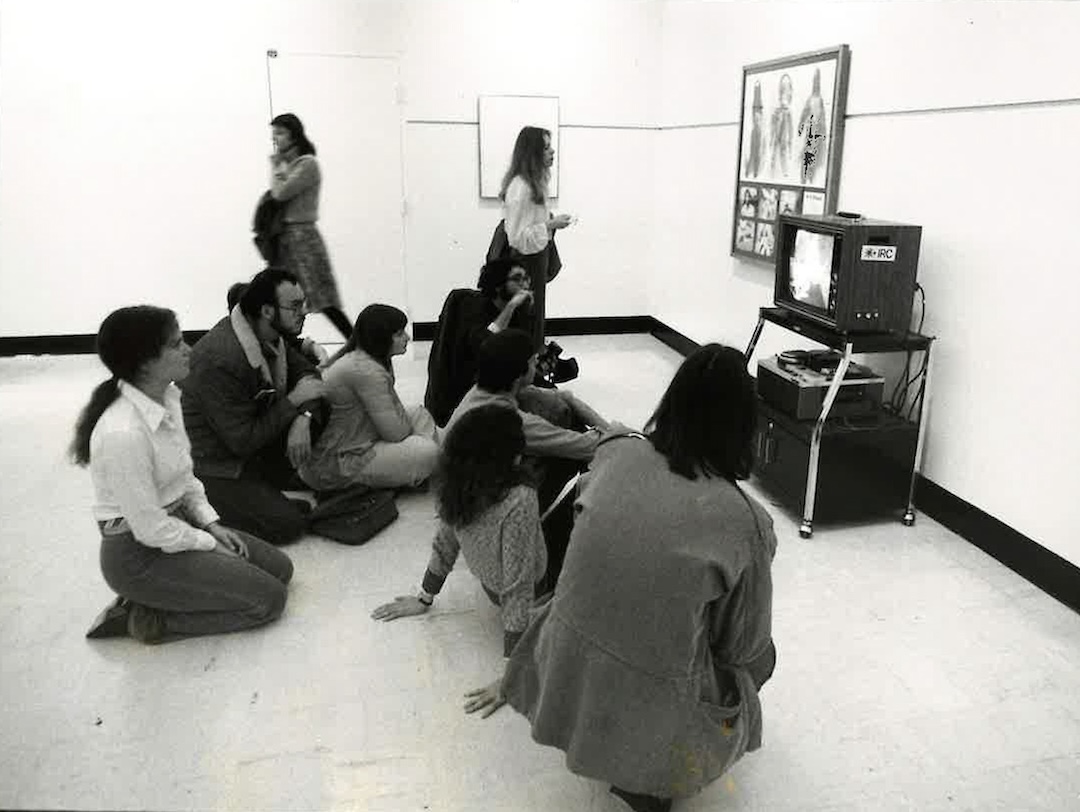
In 1976, as Jimmy Carter prepared to take office as the 39th President of the United States, 30 conceptual artists donated their works to the Georgia Museum of Art in honor of the small-town peanut farmer turned president. This unique collection, devoid of traditional paintings, featured films, video and sound tapes, photographs and works in other media, marking a significant departure from the museum’s usual exhibitions. The collection was avant-garde, and just as the country embraced Jimmy Carter, the museum welcomed the Carter Collection, hosting an exhibition and colloquium called “Open to New Ideas: A Collection of New Art for Jimmy Carter.”
For many Americans, particularly the artists in this group, Carter symbolized a fresh voice in the federal government following the turmoil of the Vietnam War, Watergate and Gerald Ford’s pardoning of Richard Nixon. In a New York Times article, Dennis Oppenheim, who hatched the idea alongside Les Levine, said, “The kind of art we make is open to new ideas…he’s conveyed to us a similar openness to new ideas.” Levine, in another article, put it as “[He] wants to put America back to feeling good about itself and people back to feeling good about one another.” By donating their works, the artists facilitated a bridge that connected Americans living in the South to the avant-garde scenes in New York and California, highlighting the sense of unity that Carter’s campaign embodied for Oppenheim and Levine.
The exhibition itself was met with a variety of opinions. Some people enjoyed the art, while others were quite apprehensive. The museum’s director at the time, William D. Paul Jr., highlighted that many people “were not adequately exposed to conceptual art” before seeing the exhibition. The Athens-Banner Herald called the exhibition “the like of which has never been seen before in these parts.”
One of the works included was Levine’s “Watergate Fashions,” line drawings that showed the Watergate participants on two different days. Included alongside these drawings was an audio tape that described the outfits of the participants. The piece emphasized the political events that led to Carter’s win and Americans’ distrust in the federal government at the time, showing the need for change that Levine felt was required.
Georgia artist Robert Welch was also featured in the exhibition. Welch interviewed Carter’s uncle, Alton Carter, the second-oldest resident of Plains, Georgia. Welch took pictures of him and later drew a mind map of Plains, reconstructing the town as he remembered it. This map was part of a bigger series Welch was doing where he drew memory pieces based on his conversations with elderly people.
The exhibition’s most popular piece was Paul Sharits’ “Frozen Film Frames: Ray Gun Virus,” which featured 8mm film strips placed behind plexiglass to produce a “tapestry-like” effect. “Open to New Ideas” also featured works by William Anastasi, Laurie Anderson, Bill Beckley, Jim Collins, Joel Fisher, Helen Harrison, Newton Harrison, Peter Hutchinson, Jerry Jones, Shigeko Kubota, Sharon Kulik, Mac Adams, Gordon Matta-Clark, Larry Miller, Duane Michals, Charlemagne Palestine and Joel Shapiro, all of which are still part of the museum’s collection.
Alongside the exhibition, there was a colloquium at the Georgia Center where the artists discussed and drew up a list of requests. Some of those requests were an art center for every community, a half hour of network television dedicated to the visual arts and appointments of artists to community planning development boards. The biggest request, however, was an arbitration board to regulate artist-dealer relations and legislation to protect artists’ rights to their works. The colloquium showed hope for a better future for the artists, as they felt that they had more of a voice in the federal government, a founding principle of Carter’s campaign.
Carter’s election drew support from many people, creating hope and trust in the federal government when it was most needed. Carter was a lifelong leader, showing the true value of leadership as a way to aid the public. This collection, even though not directly donated by Carter, shows a future of connection and hope through art, demonstrating the impact one person can have on many people.
Check out the museum’s photographs from festivities held in conjunction with the exhibition. To explore memorabilia from Carter’s political life, visit UGA’s Special Collections Libraries.
Authored by:
Isabel Davis