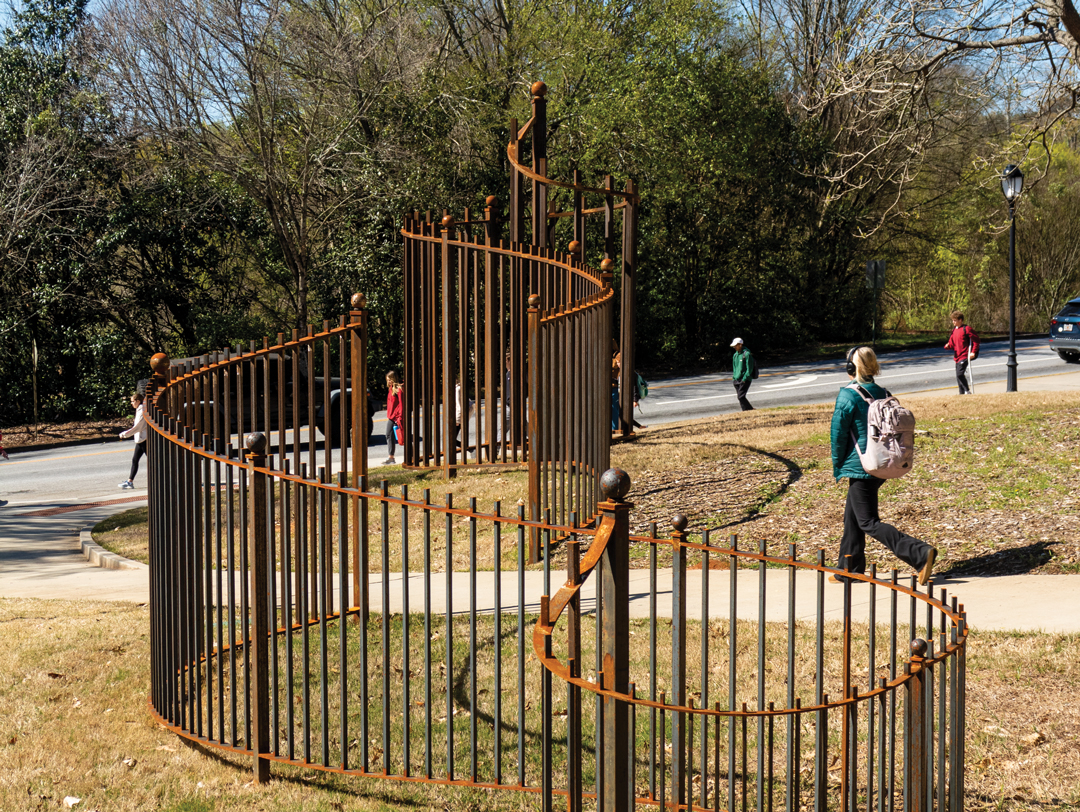
Outdoor sculpture isn’t something that is added to a museum’s collection very often. It can be expensive, it is often difficult to install and outdoor space is limited, especially for works that may be on display for the foreseeable future. Nonetheless, three new outdoor sculptures—by Andrew T. Crawford, Jane Manus and William J. Thompson—now grace the museum grounds.
JANE MANUS
Walk into the museum, through the lobby and into the Jane and Harry Willson Sculpture Garden and you’ll find “Andreas,” the most recent addition to our outdoor gallery devoted to work by women. Created by Florida-based sculptor Jane Manus and on view in the exhibition “Jane Manus, Undaunted” (which closed here on February 12), it makes a dramatic statement in the middle of the garden. Manus uses welded aluminum for her sculptures. While it is a difficult material to work with, it doesn’t rust and is much lighter than steel.
Manus has made art since she was a child. She was drawn to sculpture from the beginning, working in clay, and even had a kiln in her room in high school that she says almost burned down her house. She studied at the Art Institute in Boston, where she moved on to wood constructions, but that material has its issues, too. Wooden sculptures placed outside, where Manus wanted her work to be, often warp and decay. Her teacher Michael Phillips suggested she try welding and taught her how. “Once I started in metal, I never wanted to do anything else again. It was fast and forever and substantial,” said Manus. It is important that her sculptures work from all angles, as you walk around and sometimes through them, she added. Her artistic vocabulary is reminiscent of geometric sculptors such as Mark di Suvero, Tony Smith and Joel Shapiro, but her interpretations feel lighter on their feet. Her work was originally on display at the Georgia Museum of Art in 1996 as part of the celebrations for the opening of the University of Georgia’s Performing and Visual Arts Complex, and another one of her wall sculptures is also currently on display in the museum lobby.
Art writer Lilly Wei wrote that “Andreas” makes her “think of a greatly elongated body in abstract form. I see the semblance of a head, torso, legs and feet, recalling the way Greek temples were conceived in correspondence to the human body, with a head (pediment), torso and legs (columns) and feet (the
columns’ base). It is figurative while abstract, expressive while geometric. The result can not only be likened to the body at rest, but also to a body that is stretched, taut, on the cusp of movement, like a dancer about to make the next leap before landing nimbly into position.”
ANDREW T. CRAWFORD
If you’re familiar with one sculpture that was already on display outside the museum, you probably recognize Crawford’s name. He’s the creator of “Split,” which sits up on East Campus Road. Crawford often transforms the tools for making sculptures into sculptures themselves, and this massive 500-pound screw cleaved almost in half demonstrates themes that run through much of his work. Crawford alters the ordinary, making everyday objects feel less “rigid” and more “human” by twisting, pulling or splitting them into new shapes. The work first appeared on campus in 2006, alongside eight of Crawford’s other “ordinary” objects, and took up its permanent home in 2008 thanks to funds provided by Amburn and Will Power in memory of Mildred and Jay Huskins. Crawford makes ornamental ironwork as well as large-scale sculpture, and many of his gates can be seen around Athens and in Atlanta. Born in New Jersey, he grew up in Atlanta and his studio and workshop still are there today.
Crawford and his team installed “On the Verge” in November, just across from the museum’s Carlton Street covered parking area entrance. For a long time, it was just a series of large posts and it was hard to envision the final product, but the sculpture took shape rapidly as workers assembled sections of spiraling metal in between those posts. The result is a work that comes to life as students walk, bike or scoot through it, a passion project that differs substantively from the commercial work at which he excels. Although Crawford attended the Rhode Island School of Design (RISD), members of his family went to UGA, and he’s pleased to have one of his largest works of sculpture on its campus, where it and “Split” serve as gateways to the arts district.
WILLIAM J. THOMPSON
Walk around to the other side of the museum from “On the Verge,” and you’ll find a sculpture by William J. Thompson titled “Archangel” on a pedestal near the museum’s main entrance. Thompson is perhaps best known locally for creating the “Spirit of Athens” sculpture downtown in conjunction with the 1996 Olympic Games. He also made a memorial at Andersonville National Park, commissioned by the Georgia Natural Resources Commission to commemorate lost prisoners of all American wars. Born in Denver, Colorado, Thompson, like Crawford, studied at RISD. After serving in the U.S. Army and receiving his master of fine arts degree from Cranbrook Academy of Arts, he taught at UGA’s art school from 1964 to 1983. The Lamar Dodd School of Art’s sculpture studio is named in his honor.
The museum owns many works by Thompson: prints, drawings, several smaller sculptures. But until now it did not have a large work. Given his importance to Georgia and to UGA, it made sense to acquire one, and his children generously donated this addition to our collection. Thompson died in 1995. He originally made this sculpture in 1967, in aluminum and fiberglass. It was included in the 1969–1970 Smithsonian National Traveling Exhibit. The original sculpture was not in good condition, so Jack Ward, who worked closely with Thompson many years ago, and Joe Thompson (the artist’s son and a sculptor in his own right) recast it in bronze in 2022, enabling us to install it outside. Like many of his works, it reaches toward the sky, mirroring Beverly Pepper’s sculpture “Ascension” nearby.
Authored by:
Museum Staff