For Carina Crucho, a Fulbright Visiting Scholar, exploring Athens and the UGA campus has been a source of inspiration. On her blog, she writes about her experiences here with thoughtful observations and insight. Recently, she visited the Georgia Museum of Art and wrote about how profound the experience of seeing works that were at the intersection of art and science were to her as a female scientist.
Discovering the Intersections: Art and Science at the Georgia Museum of Art
By Carina Crucho
Picture this: a 38-year-old researcher, embarking on a quest to explore the intersection of art and science at the Georgia Museum of Art. February holds significance for those advocating for gender equality in science, marked by two key events: the International Day of Women and Girls in Science and the Global Women’s Breakfast. These occasions serve as rallying points for individuals of all genders to actively participate in networking events that aim to overcome barriers to gender equality in science.
My journey as a woman in STEM (Science, Technology, Engineering, and Mathematics) and as a Fulbright scholar led me to the Georgia Museum of Art, where art […] is used to deepen understanding of STEM concepts. This is not the first time I have contemplated the integration of art into STEM, realizing how art can enhance our comprehension of scientific concepts. Years ago, during an IVLP themed “Advancing Women in STEAM fields,” I visited “Outbreak” at the Smithsonian National Museum of Natural History in Washington, DC. The immersive storytelling experience […] within the exhibition made me unconsciously stop breathing, like I was going to be infected by some airborne virus. The exhibition’s vivid communication of complex scientific ideas exemplified just how effectively art can convey STEM concepts to the public, a fundamental principle of a democratic society.
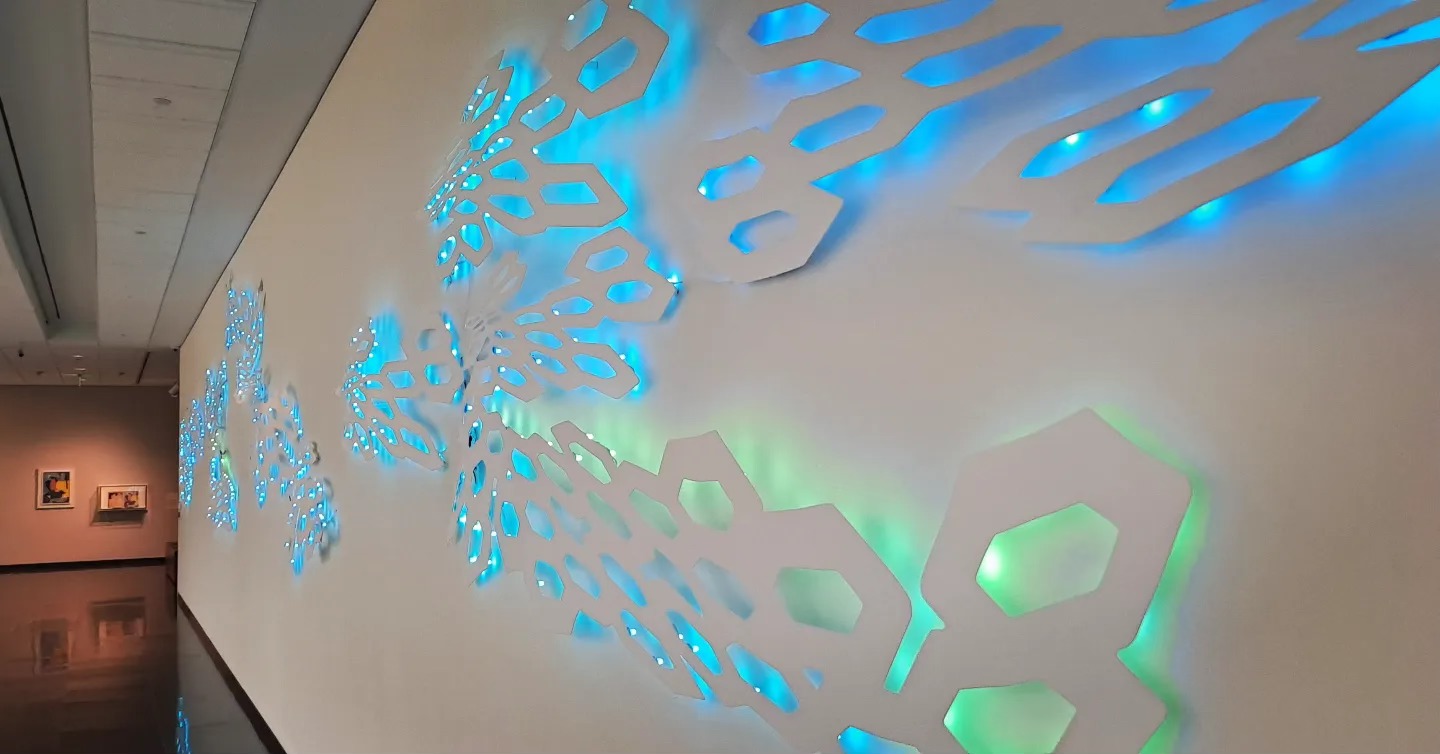
Within the Georgia Museum of Art’s walls, I discovered a fusion of creativity and intellect that blurred the boundaries between STEM and the arts, and highlighted the concept of STEAM (Science, Technology, Engineering, Arts and Mathematics.) The installation piece “Shimmer,” by Rebecca Rutstein, draws inspiration from the intricate chemical and biological processes of Mexico’s Sea of Cortez at the Guaymas Basin. The installation’s stretched and hexagonal steel forms mirror the unique carbon-cycling phenomena found in this marine environment. Moreover, the interactive lighting ingeniously mimics the bioluminescent patterns of siphonophores in the deep sea—a phenomenon wherein living organisms emit light, facilitated by the molecule luciferin, derived from the Latin lucifer, meaning “light-bearer.” Delving deeper into Rutstein’s background, I discovered her renowned multidisciplinary approach and profound interest in geology, microbiology and marine science. This collaborative endeavor with UGA oceanographer Samantha Joye (UGA Regents’ Professor, Georgia Athletic Association Distinguished Professor of Arts and Sciences and professor of marine sciences) epitomizes the essence of STEAM: a dynamic partnership between two women at the forefront of their respective fields. As I crossed the corridor, I couldn’t help but resonate with the tangible presence of STEAM enveloping the space, and my own profound appreciation for the intersection of art and science.
The temporary exhibition “Kei Ito: Staring at the Face of the Sun” presents another immersive journey into the profound impact of nuclear weaponry. Skillfully portrayed through the lens of photography, the works were inspired by personal history. Ito’s grandfather, a survivor of the atomic bomb dropped on Hiroshima, vividly recounted the cataclysmic event as witnessing “hundreds of suns lighting up the sky.” With photography as his medium, Ito delves into the microscopic realm, capturing the invisible yet potent force of radiation. His lens not only connects this force to the human body but also metaphorically illuminates the worldwide effects of nuclear weapons. Through the play of light captured in his photographs, reminiscent of a myriad of suns, Ito artfully contrasts the beauty and brutality of the power of an atom, inviting viewers to contemplate the consequences of such immense energy unleashed.
Amidst these experiences, the role of art as a transformative force in advancing gender equality in science cannot be overlooked. Art transcends language and culture, evoking emotions, sparking conversation and challenging societal norms. By showcasing the achievements of women alongside their male counterparts, the museum celebrates diversity, fosters inclusion and inspires future generations to pursue their passions without hesitation.
As we continue our journey towards gender equality in STEAM, let us exploit the transformative power of art to challenge perceptions, ignite imaginations and drive positive change. Through collaboration, advocacy and creativity, we can create a future where every individual, regardless of gender, thrives and contributes to the advancement of science and society.
Crucho is visiting UGA from Portugal and is working with UGA’s David Crich to develop targeted oral delivery strategy for antibiotics:
Carina Crucho obtained her PhD degree in Chemistry at NOVA School of Science and Technology, Universidade NOVA de Lisboa. She is currently a Junior Researcher at Institute for Bioengineering and Biosciences, Instituto Superior Técnico. She is a highly motivated and enthusiastic researcher working on the design and synthesis of smart materials for biomedical applications. Throughout her career, she has received several awards and honors, including the L’Oréal Award for Women in Science, and participated in the CAS Future Leaders program. As a Visiting Scholar Researcher at the University of Georgia, Carina will have the opportunity to work with Prof. David Crich to develop a targeted oral delivery strategy for aminoglycoside antibiotics based on organosilica nanoparticles. Her research period in the United States will allow her to acquire new expertise in the synthesis of carbohydrate-based antibiotics.
Authored by:
Carina Crucho