

Family Day this month focuses on a style of art called realism. This kind of art started in France in the 1840s. Realist artists tried to capture the people and experiences they saw around them. Earlier artists thought these things were too common to paint. Read on to learn more about realism. Then capture your own life in a neighborhood collage.*
Close Looking

Eugenie McEvoy was born in New York, but her parents died when she was young. She grew up in France with her aunt and uncle. When she was a teen she toured the world as a champion sharpshooter. Her nickname was the “Little French Annie Oakley.” As an adult she returned to New York and bred collies for dog shows, managed theatrical production companies, and hosted a thriving arts community at her resort in Woodstock, New York.
In “Taxi! Taxi!”, McEvoy captures an everyday cab ride in New York City in 1933. You can see the inside of the cab and the activity of the street outside. Take a moment to look at the painting. How many people do you see inside the cab? Do you think it is a smooth or bumpy ride? What sounds do you think you might hear out on the busy street? In 1930, public transportation included green double-decker buses. How many buses do you see in this painting? How would riding the bus be different from a ride in a taxi?

Harry Gottlieb was born in Bucharest, Romania. He moved to the United States with his family when he was 12 years old. Gottlieb studied art in college and eventually moved to New York City to be an artist.
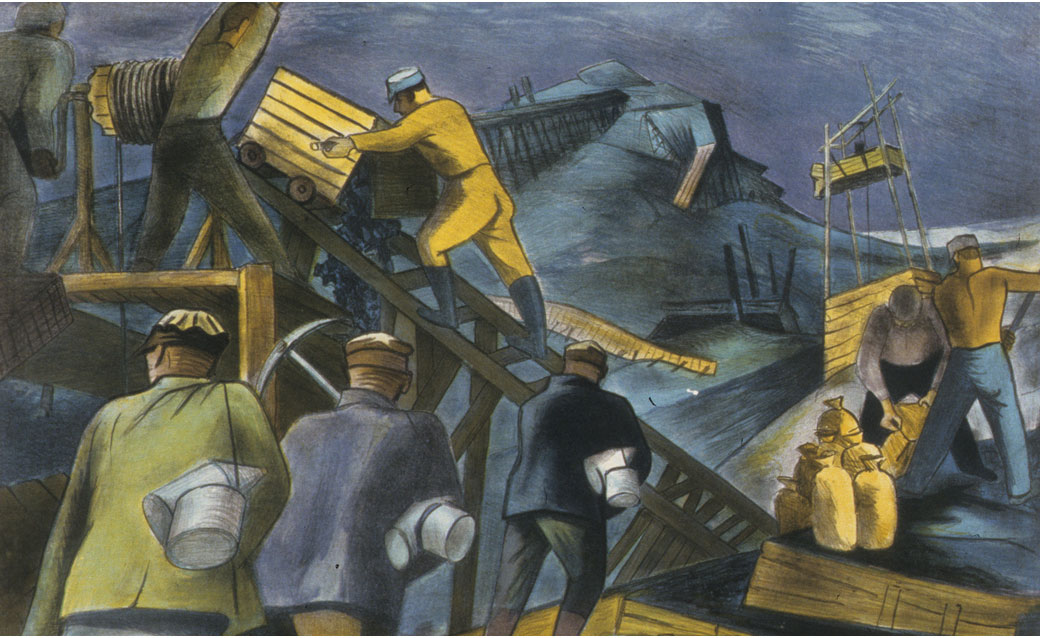
In 1935, Gottlieb worked for the Federal Art Project (FAP). This government program supported 10,000 artists and craft workers. FAP was part of the Works Progress Administration (WPA). The WPA provided jobs for people during the Great Depression.
Many artists during this time used a style of realism called social realism to document how working-class people were treated in their jobs. They thought workers were heroic and important. Compare these two prints by Gottlieb. How are they similar? How are they different? What are the people doing in each print?
Everyday Art: Neighborhood Collage
Create your own realism-inspired work of art. First, explore your neighborhood by taking a walk outside. Make a list of the people you see, the houses around you, and anything else you think is interesting. Use your list as inspiration to make a neighborhood collage. A collage is a type of art that layers small materials together to create a new, larger whole.

You will need the following supplies (included in the art kit* or found at home):
- Sheet of chipboard (or cardstock)
- Scissors
- Glue or glue stick
- Colored paper
- Pencil
- Cotton balls (for clouds)
Directions:
- Start by cutting out pieces of colored paper to make your house and the buildings in your neighborhood. What shapes and colors do you want the roofs, doors and windows to be?
- Before you start gluing the paper down, arrange your pieces in different ways. Put shapes together and on top of each other to create buildings. Cut out more shapes as needed.
- Now that your houses are coming together, think about your street. What shape and color should it be? Is there a curb? A sidewalk? Cut out and arrange shapes for your street.
- The last step before you start gluing is to create the sky. Cut and arrange the paper for your sky.
- Now start gluing your paper down! Think about how you will layer the shapes as you glue them down.
- Once your sky, houses and road are glued down, add details like people, trees, cars or animals. You can use cotton balls for clouds.