

Our last Family Day focused on the exhibition “Object Lessons in American Art: Selections from the Princeton University Art Museum.” That exhibition includes 400 years of American art. It is inspired by the idea of an object lesson — the idea that a physical thing can communicate information and tell a story.
Different groupings in the show mix art together in new ways that might add to or change our understanding of the past and present of this country. (Check out the exhibition in person through
May 14, 2023.)
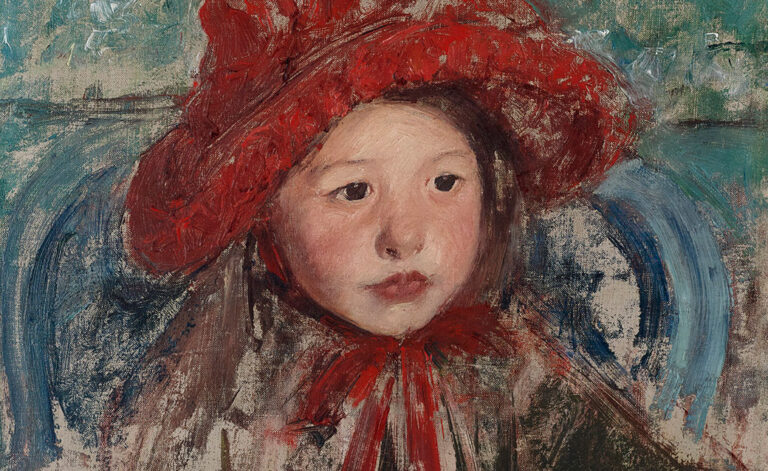
Many works of art in this exhibition are examples of three major types of paintings: portraits, landscapes and still lifes. Portraits show a person or a group of people, landscapes show a view of nature, and still lifes show mostly objects that are either natural or man-made. Check out these images for an example of
each type. What do you notice?

Mary Cassatt (1844 – 1926), “Little Girl in a Large Red Hat,” ca. 1881. Oil on canvas, 43.8 × 38.7 centimeters. Princeton University Art Museum. Museum purchase, Fowler McCormick, Class of 1921, Fund (2021-12).

Asher Brown Durand (American, 1796 – 1886), “Landscape,” 1859. Oil on canvas, 77 × 61.5 centimeters. Princeton University Art Museum. Gift of J.O. MacIntosh, Class of 1902 (y1955-3249).

Severin Roesen (German, 1816 – ca. 1872), “Still Life with Fruit and Champagne,” ca. 1863 – 72. Oil on canvas, 51.4 × 78.1 centimeters. Princeton University Art Museum. Museum purchase, Kathleen Compton Sherrerd Fund for Acquisitions in American Art (2019107).
Choose two of these works of art to compare and contrast. What are some differences and similarities? Does comparing two works of art add to or change your understanding of each one?
“Object Lessons in American Art” includes many styles of art from different cultures and time periods. They are mixed together in thoughtful ways that tell new stories.
Now it is your turn to mix together works of art to tell a new story.
To make your collage, you’ll need the following supplies:
- chipboard or cardboard
- reproductions of art (you can cut these out of magazines or use photographs you might have)
- colorful and patterned paper
- glue
- scissors
- kraft paper or newspaper

Directions:
- Cover your work area with newspaper or kraft paper for easy clean-up.
- Look through your art reproductions and colored/patterned paper.
- Decide on a background and cut it out.
- Glue the background onto the chipboard.
- Start cutting out people and things from your art images.
- Arrange the pieces you cut out in interesting ways and glue them on your background.
- When you are finished, talk with someone you are with about what kind of new story your collage tells.