

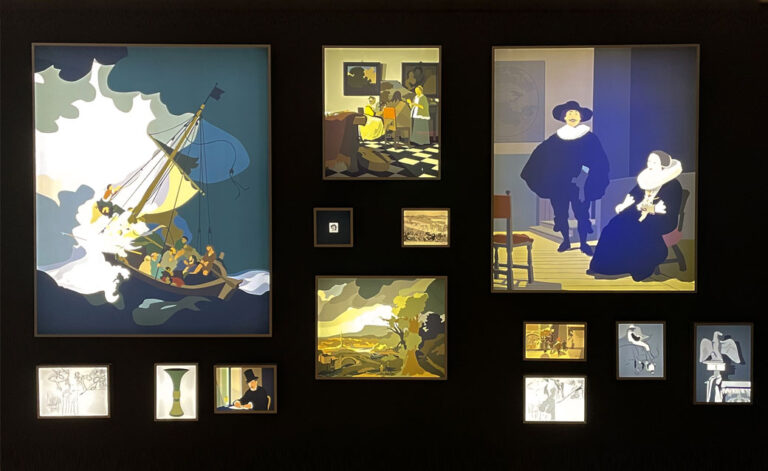
On the morning of March 18, 1990, a group of people disguised as police officers entered the Isabella Stewart Gardner Museum in Boston.
Eighty-one minutes later the thieves left the museum with 13 works of art. These works were by famous artists including Rembrandt, Manet, Degas and Vermeer. The thieves cut out some of these works from their frames. The stolen objects are valued today at more than $500 million. This heist remains the largest unsolved art theft in history.
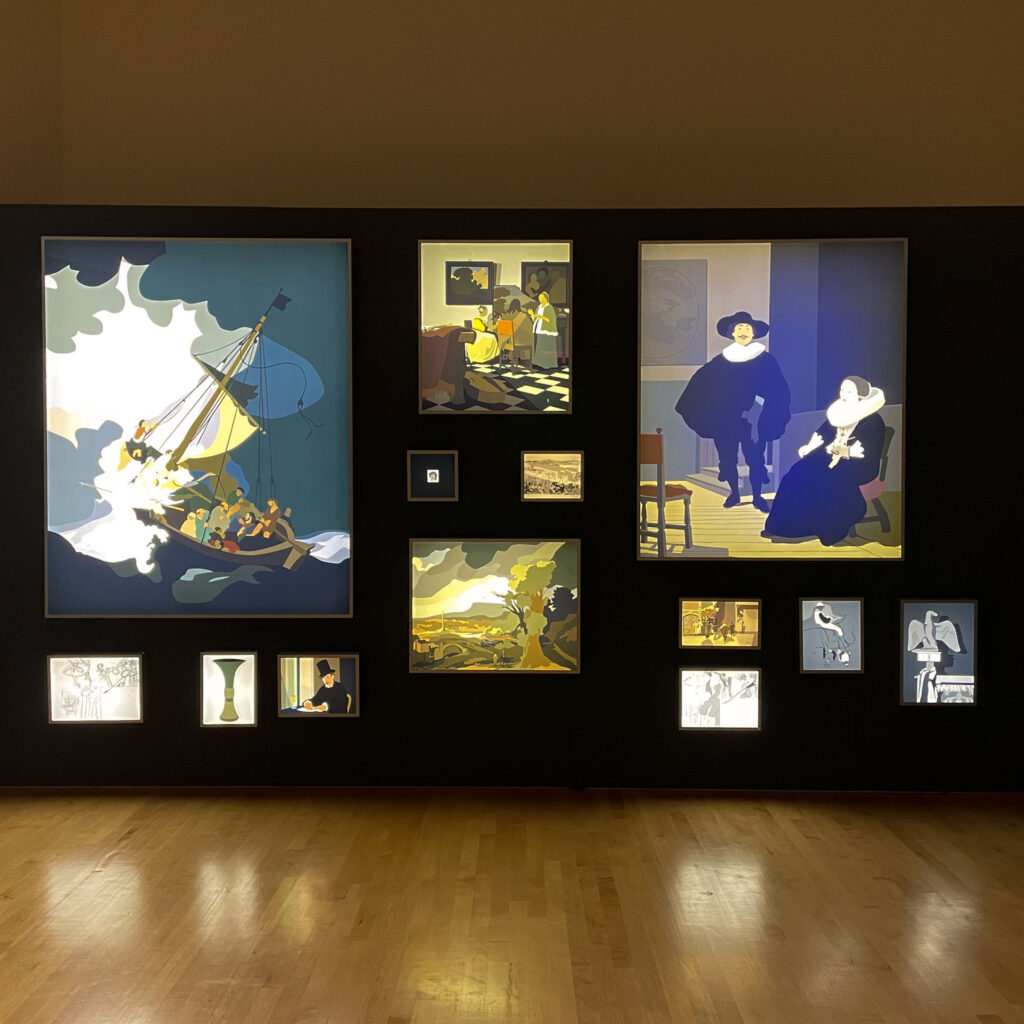
The exhibition “Kota Ezawa: The Crime of Art” is inspired by this heist and other art crimes. The artist Kota Ezawa re-created the stolen works of art in his own style. Ezawa says, “I developed a style of drawing where I manually trace over existing films, videos, photographs, and paintings.” The result is a unique work of art that looks flat and graphic. Check out the exhibition in person until December 5.
Empty Frames
Isabella Stewart Gardner was an art collector. She built the museum named after her to house her and her late husband’s collection of art. She lived on the fourth floor of the building. Gardner personally arranged works of art in the galleries.
She died in 1924 and left the museum “for the education and enjoyment of the public forever.” Gardner also left instructions that nothing in the galleries could ever be changed, even after her death. Because of her instructions, the empty frames that held stolen works remain exactly where she hung them in the galleries.
 Kota Ezawa (Japanese-German, b. 1969), “Empty Frame,” 2015. Duratrans transparency and LED light box, 24 1/2 × 33 1/2 inches. Courtesy of the artist, Christopher Grimes Gallery, Santa Monica, and Haines Gallery, San Francisco.
This light box by Ezawa shows the empty frame where Rembrandt’s “The Storm on the Sea of Galilee” once hung. (See the next page for an image of this painting.) The theft of this painting and the others is a great loss. Perhaps the objects will someday be returned and the mystery solved.
To tour the Gardner Museum virtually, visit:
https://artsandculture.google.com/partner/isabella-stewart-gardner-museum
Close Looking: Mindset of a Thief
Look closely at these two images. How are they different? How are they the same?
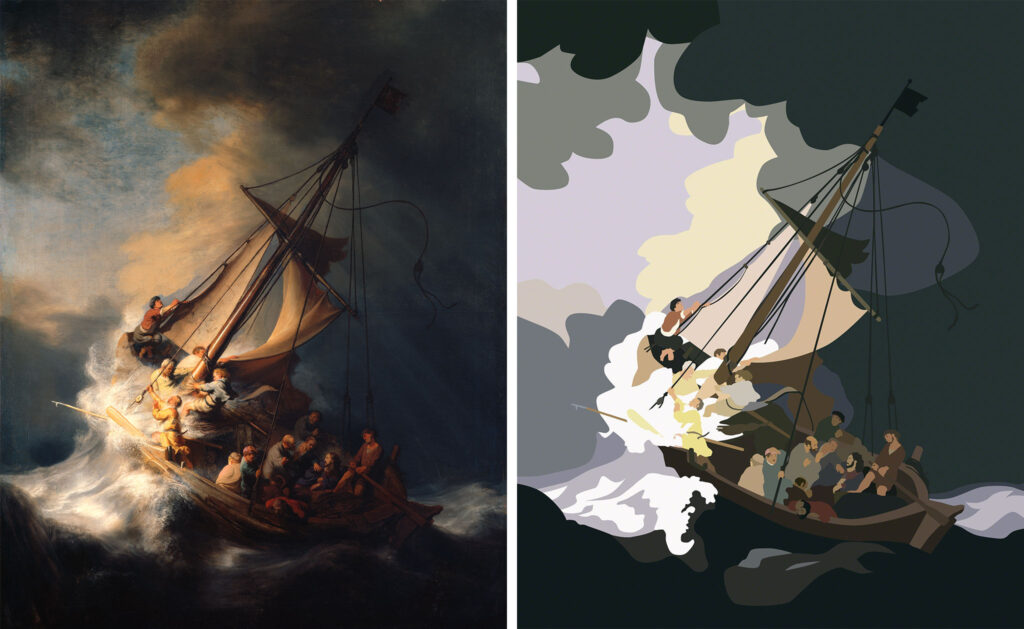 (left) Rembrandt van Rijn (Dutch, 1606 – 1669), “Christ in the Storm on the Sea of Galilee,” 1633. Oil on canvas, 63 x 50 3/8 inches. Isabella Stewart Gardner Museum, Boston (P21s24). (right)Kota Ezawa (Japanese-German, b. 1969), “The Storm on the Sea of Galilee,” 2015. Duratrans transparency and LED light box, 62 1/2 × 50 1/2 inches. Courtesy of the artist, Collection of Nion McEvoy and Christopher Grimes Gallery, Santa Monica.
The painting pictured on the left was stolen in the Isabella Stewart Gardner Museum heist. It is Rembrandt’s only known seascape. He skillfully renders the movement and energy of a boat caught in a storm at sea.
Kota Ezawa highlights colors and shapes from the original painting to create his work of art. He said, “In a way, I’m creating some kind of ghost image of the original.” When he describes this process, he says, “I do feel some kind of affinity to the mindset of a thief.” What do you think he means? Is he stealing ideas from other artists?
Artists often borrow ideas or “steal” from each other. How could this be a good thing or a bad thing?
Ghost Image
Now it is your turn to create a “ghost image.” The light box below is inspired by another one of the stolen works of art from The Isabella Stewart Museum heist.
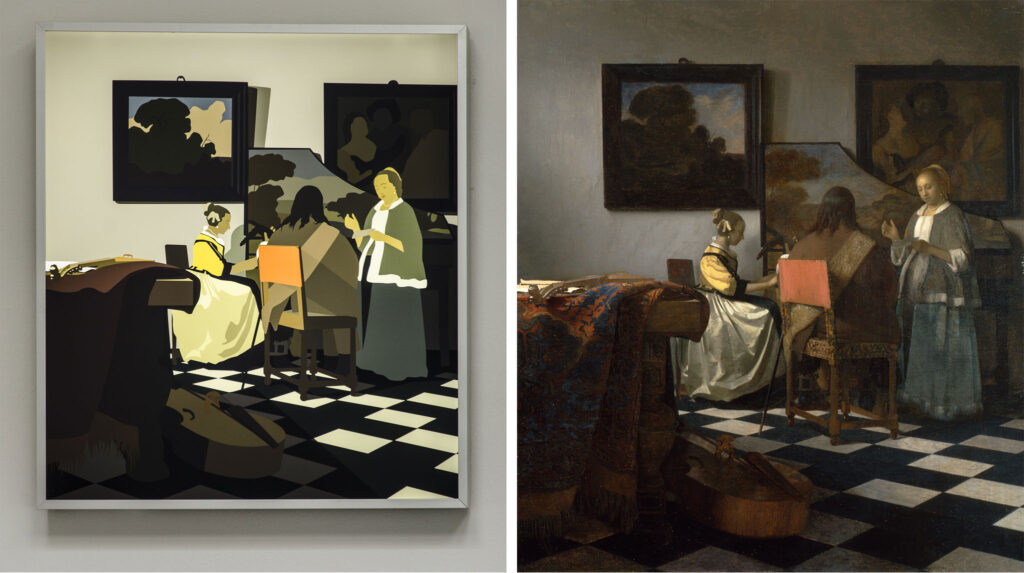 (left) Kota Ezawa (Japanese-German, b. 1969), “The Concert,” 2015. Duratrans transparency and LED light box, 28 1/2 × 25 1/2 inches. Collection of Nion McEvoy. (right) Johannes Vermeer (Dutch, 1632 – 1675), “The Concert,” 1633 – 66. Oil on canvas, 28 9/16 × 25 1/2 inches. Isabella Stewart Gardner Museum, Boston (P21w27).
You’ll need the following supplies included in the art kit (or found at home).
- vellum paper
- colored pencil
- pencil sharpener
- paper clips
- picture of a work of art
Directions:
- Find the print of Kota Ezawa’s “The Concert” or find an image of another work of art to use.
- Place the vellum paper over the print. Paper clip it in place so it doesn’t move while you are tracing over it.
- Find a shape you want to trace. Choose a colored pencil that matches it. Trace the shape with the matching color and fill it in.
- Continue tracing and filling in shapes until your work is finished. Repeat with other images.
TIP: You can hang your ghost image in a window to create the effect of a light box.
We’d love your feedback! Please take a few minutes to complete a survey about this program.
Family Day art kits are sponsored by Lucy and Buddy Allen and the Friends of the Georgia Museum of Art.