

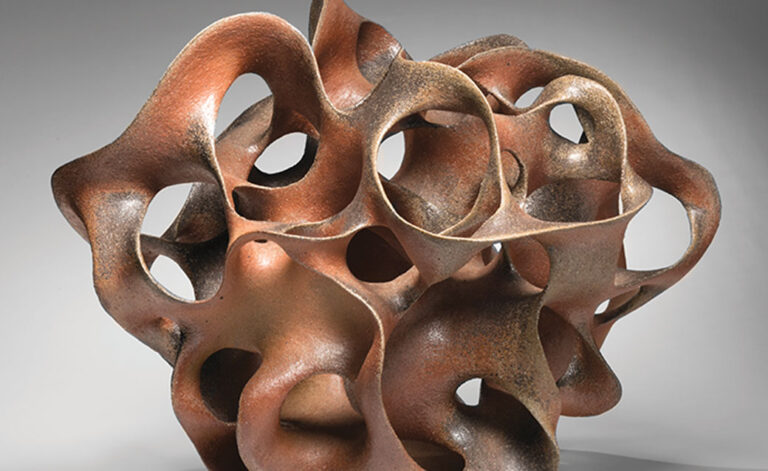
Kurokawa Toru is a Japanese artist who focuses on creating what he calls liquid shapes. He uses ceramic materials to make sculptures of organic forms — irregular shapes that look like things found in nature. Kurokawa’s sculptures resemble natural forms that could be found on a walk or underwater. The sculptures emphasize movement and natural beauty. What do you notice about this sculpture?
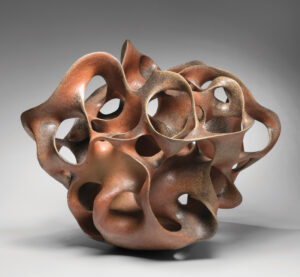 KUROKAWA Tōru (Japanese, b. 1984), “Protocell-E,” 2016. Natural ash-glazed stoneware, 19 1/2 × 25 × 20 1/2 inches. Collection of Carol and Jeffrey Horvitz, JC2017.014.
Here, he bends and twists clay into an intricate shape that mimics coral or rock. He takes a small, natural formation and transforms it into a large ceramic sculpture. Does this work of art remind you of anything you’ve seen in nature?
In this activity, you’ll make a paper sculpture that resembles organic forms found in nature.
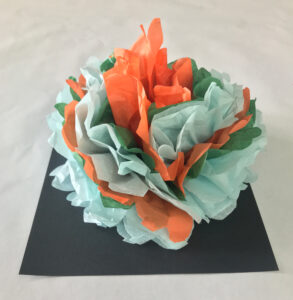
For this activity you will need:
- tissue paper
- scissors
- glue or tape
- pipe cleaners or a piece of wire
- construction paper
To make your paper sculpture:
- Choose 8 to 12 pieces of tissue paper. They can be a mix of colors or all the same. What inspires you? The more pieces of paper you choose the larger your final sculpture will be.
- Stack the sheets of tissue paper and fold them like an accordion or a fan. Continue until the entire stack has been folded. Be sure to press down to crease the folds!
- Use scissors to cut rounded edges on the short ends of the tissue paper. You could also try cutting the ends into points or two different shapes. This will help give your sculpture shape.
- Wrap a thin wire or pipe cleaner around the middle of the folded paper.
- Gently fan out each piece of tissue paper. Carefully pull each layer up until they form a three-dimensional shape.
- Glue or tape the flat end of the paper sculpture to a construction paper base.