Homage/Hijack
This small exhibition was organized by Rachel Gooch and Sophie Johnson, both art history students at UGA. It highlights six works by American artists who reference, repurpose and/or duplicate known imagery and ideas influential to American art and culture.
Whether in bronze copies of great marbles or mass reproductions of popular material culture, art has long walked the line between appreciation and appropriation. For a long time, critics saw American art as a visual culture forever one step behind European art. But American art also developed over the course of centuries, pulling inspiration from culturally diverse populations. We hope to showcase in these works the interconnectedness of styles, history and creativity in the American canon. All six artists were successful through revolutionary execution of their medium. And each work addresses the question of what defines appreciation versus appropriation.
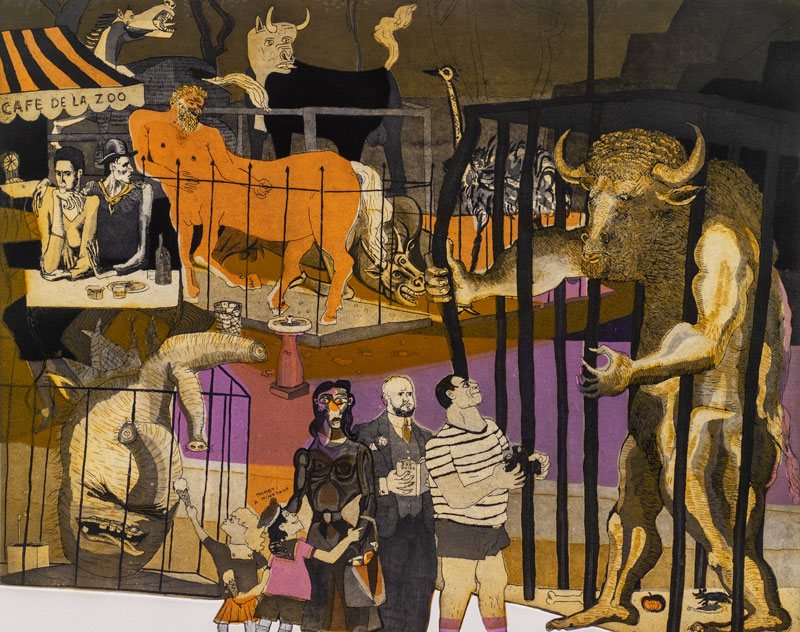
Warrington Colescott is an American artist best known for his wild imagination. The work here comes from a series in which he puts to paper the comical and unseen moments of printmaking history. Other works in the series show a scandalous dinner at Henri de Toulouse-Lautrec’s home and Francisco de Goya taking notes on the battlefield to document the disasters of war. In each one, Colescott incorporates humor and mimics each subject’s own artistic expression. This work showcases some of Pablo Picasso’s most notable figures — the horse and bull from “Guernica,” the emotionless couple from “The Frugal Meal” — in the midst of a packed zoo. Picasso and his portrait of Dora Maar make an appearance, too. Colescott took the known in art and transformed it into something new. These works of his dance on the line between appreciation and appropriation in an exciting way.
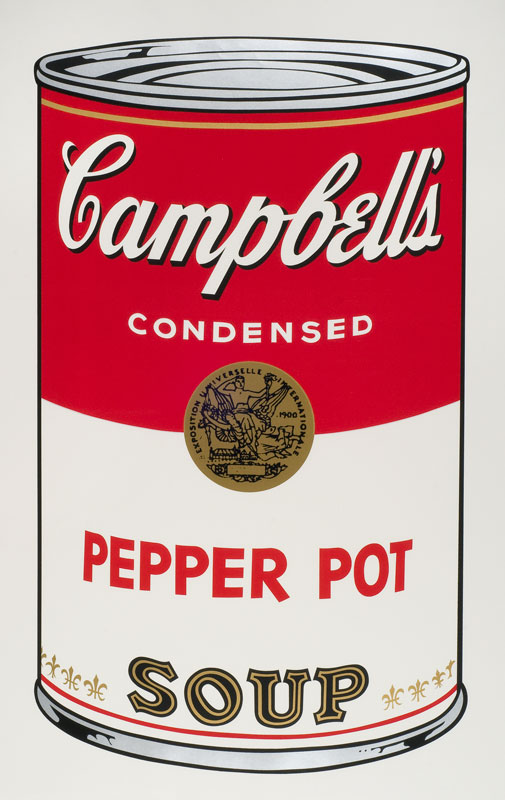
Artist and filmmaker Andy Warhol pioneered the American Pop art movement of the 1960s. Pop art reclaimed and appropriated commercial imagery to transform it into art. Warhol screenprinted images of all 32 soup flavors offered by the Camden-based soup company. We have chosen to display “Pepper Pot Soup” for its relevance to appreciation versus appropriation of culture. Popularized in Philadelphia, pepper pot soup was a community staple brought across the Atlantic by the enslaved populations of West Africa. Commercialized by Campbell’s (though still retaining somewhat original ingredients) and incorrectly marketed as a soup enjoyed by colonial aristocracy, pepper pot has undergone not one but two instances of “upcycling” in American culture.
Learn more about the history of pepper pot.(opens in new tab)
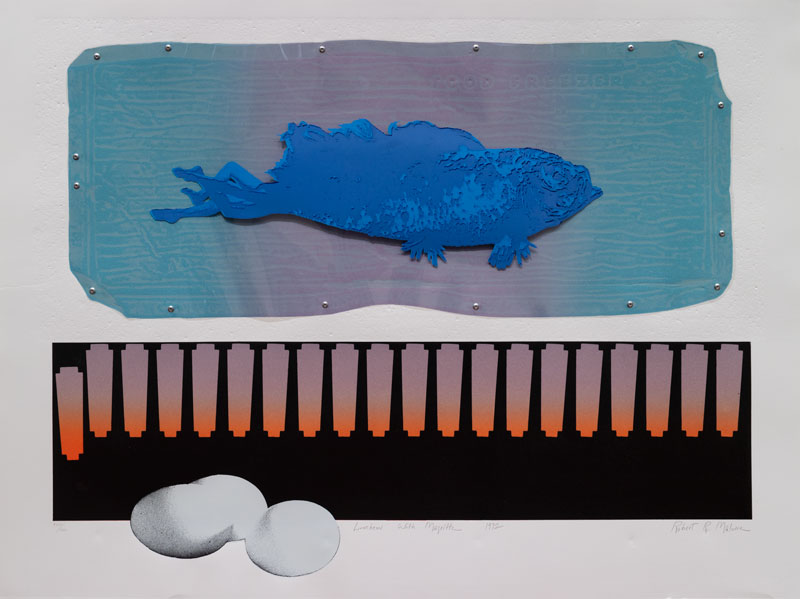
Robert Malone’s prints often use eye-catching motifs, letters and figures to deal with issues of perception and themes of the sublime. Here, he appropriates the distinct surrealist forms of the Belgian artist Réné Magritte. The recognizable imagery of the “mermaid” fish from Magritte’s painting “Collective Invention” has a distinctive printmaking spin, appearing here as a gyotaku-styled overlay. Gyotaku is a Japanese way of making prints by using a fish as a printing plate. Following Magritte, Malone takes the familiar and makes it unsettling. The single displaced architectural form creates issues of perception and artistic origin within the work and the viewing experience: Are these columns or coffins? Is this Magritte or Malone?

Roy Lichtenstein’s appropriation and elevation of comic book style makes his work iconic and identifiable. His often tongue-in-cheek imitations are an important part of the Pop art movement. Liechtenstein doesn’t shy away from the artificial elements of the comic book style. The vibrant primary colors and uniform dots immediately grab one’s attention. He also borrows from another art form in this image. Both the title and the text blurb come from the lyrics of Hoagy Carmichael’s hit 1927 jazz song “Stardust.”

Born in 1918, Sister Mary Corita Kent was a Catholic nun who broke into the male-dominated Pop art world. She is best known for her manipulation of commercial texts to assert meaningful depth. Her early works, like this one, often appropriate the Byzantine and medieval art forms that she studied at Immaculate Heart College. The scene in this image depicts the moment in the Gospel of John when Jesus performs the first of many miracles, turning water into wine. The figures of Jesus and Mary at the upper right mirror early Christian mosaics. Kent’s lively and colorful adoption of recognizable religious imagery appealed to mass American audiences in ways that traditional Catholic preaching did not. As a result, she often found herself in hot water with church leaders regarding her art.

Contemporary Athens artist Jim Fiscus aims to muddy the line between commercial and artistic photography. He brings popular culture and mysticism together in this photograph. Fiscus invites his audience to consider every aspect of the story the image presents. From the combination of streetwear and traditional ringmasters’ garb to the omniscient stance of the rapper, Fiscus’s photograph conveys a sense of awe and wonder. The overall visual language of the piece suggests a tarot card. It is almost as if Ludacris is a great hierophant (or priest), showing his power and brilliance of mind through his music and stance. As the ringmaster, he is the leader of the show and the main point of connection between audience and inspiration.